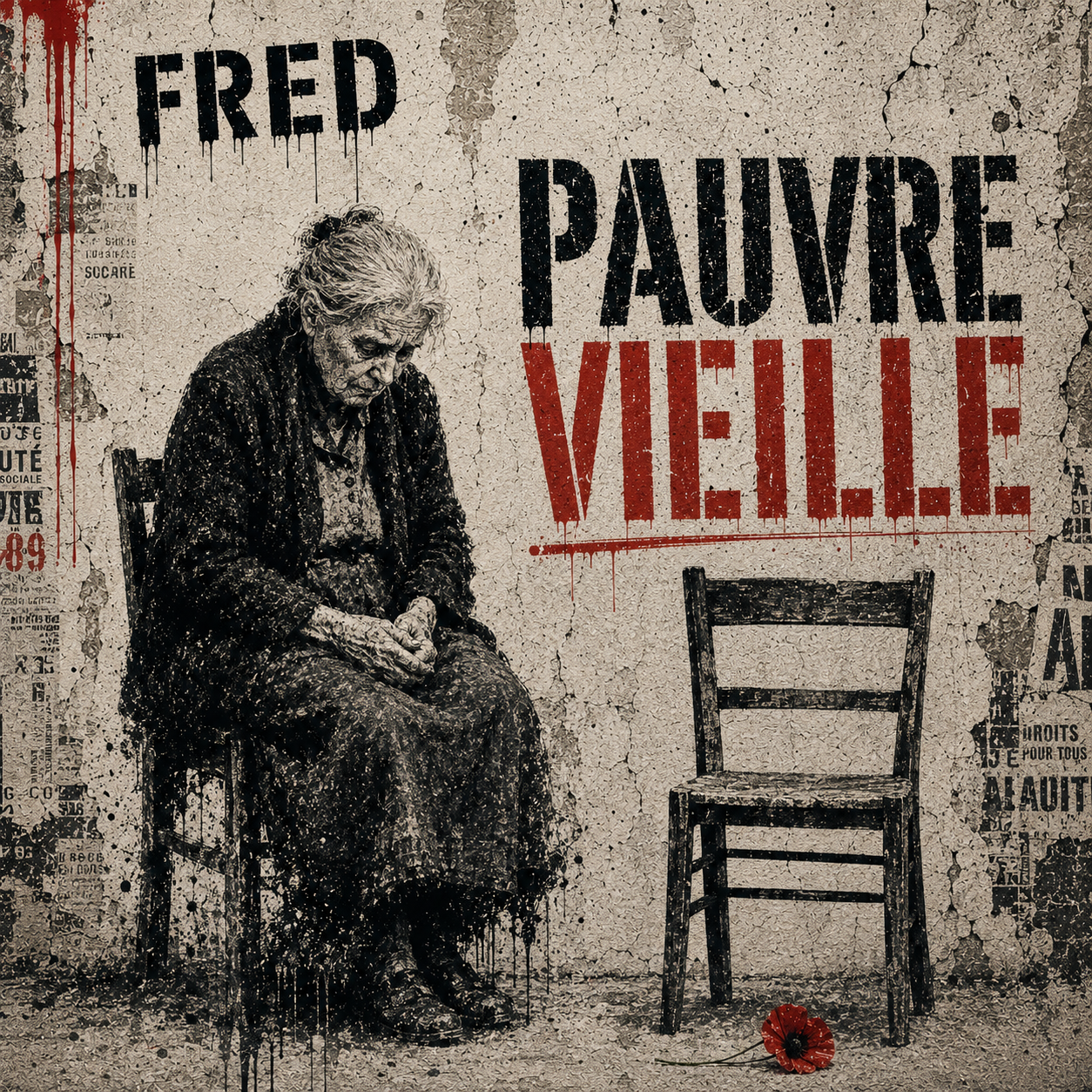
There are songs that tell an event. And then there are songs that stop just afterward, when everyone seems to have understood what has happened, but someone is still there with what the others can no longer see.
Pauvre vieille begins there.
A man has just died. His wife remains seated, almost motionless, in the house where gestures, objects and habits still carry his presence. Nothing spectacular. No grand speech. A worn chair, an apron twisted between her fingers, a lamp, memories returning. And the terrible feeling that time, suddenly, no longer leads anywhere.
The song could have remained a simple text about grief. But it belongs to Le Pavé, and Le Pavé rarely looks at things without scratching a little beneath the surface.
Little by little, something else appears.
The children arrive. They speak softly and probably do what is expected of them. Yet behind the words another mechanism is already setting itself in motion: the accounts, what will remain, what each person will receive. The man who has just died almost immediately begins to belong to the past, while for the woman who shared his life, he is still everywhere.
This is where Pauvre vieille becomes less comfortable.
Because it is no longer only about death. It is about that moment when an older person can suddenly become, in other people’s eyes, the one who is left. The one around whom the next steps are arranged. The one everyone assumes will eventually accept, understand and resign herself.
But in the middle of all this, she goes on loving.
And perhaps that is what moves me most in this song: the old woman is never reduced to a fragile silhouette. Her silence is not empty. It contains a whole life — summers, children, ordinary gestures, a man with whom she passed through the years. Everything that looks tiny from the outside becomes immense when it disappears.
In Le Pavé, violence does not always need to shout. It can be social, familial, almost ordinary. It can fit inside a sentence spoken too soon, a gaze already shifting toward what comes next, in the way we sometimes consider a life to be over simply because one of the two people who made it up has died.
Pauvre vieille is not trying to teach a lesson.
It simply sits there beside her.
And listens to the silence everyone else already seems in a hurry to fill.