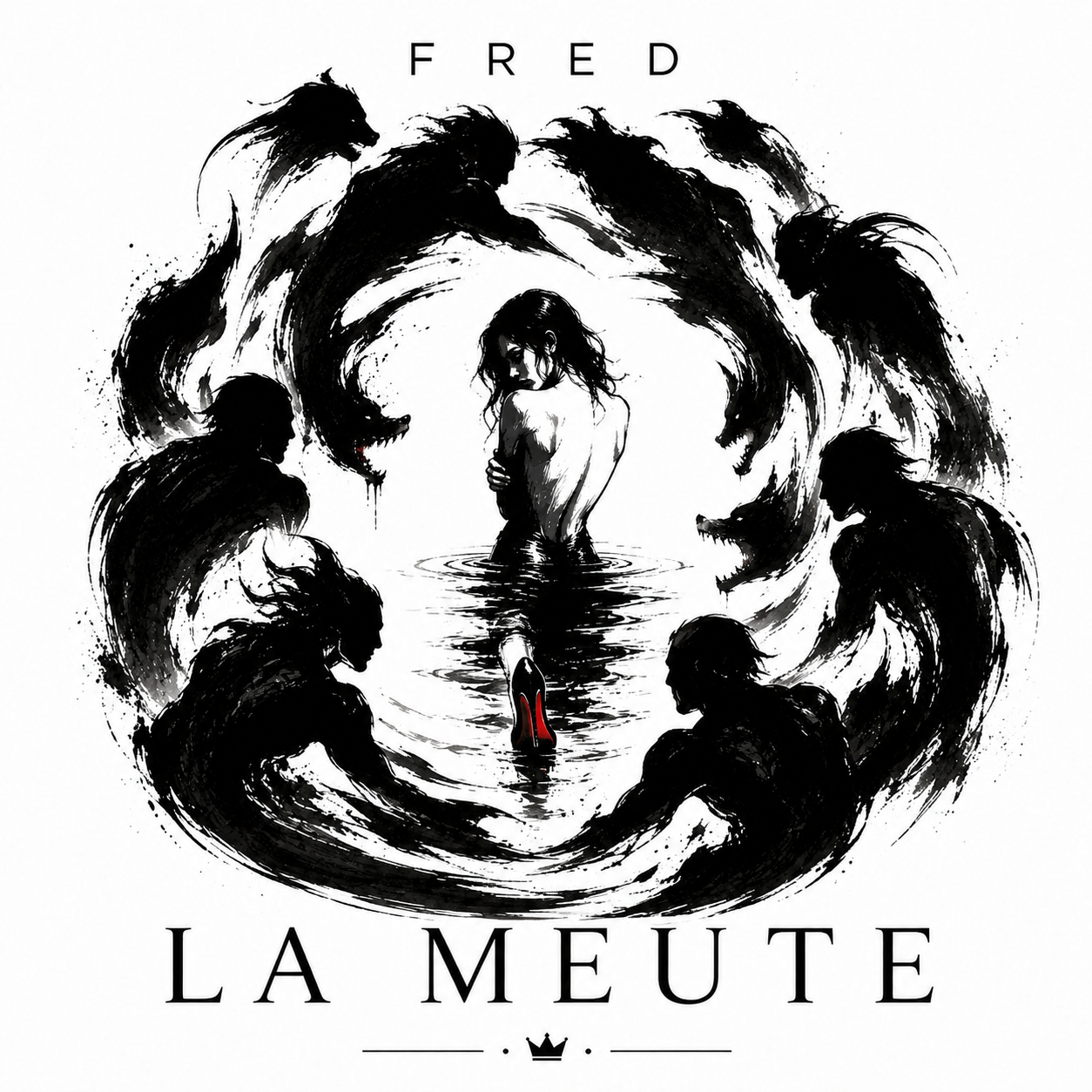
La Meute belongs to CAMLAND, but it no longer looks at the screen in the same way as Rina. Here, there is no longer really one man facing one woman. There is a group. Usernames, requests, tokens, reactions building on one another until individual responsibility begins to dissolve into something larger.
The song was born around a simple and rather dark idea: alone, each person might hide his shame; together, they end up calling it permission. What is being observed is no longer only one individual’s desire, but the way a group can drive itself onward, gradually push back its own limits and turn a situation each person would have experienced differently into a collective dynamic.
To tell this, La Meute deliberately leaves the realistic webcam setting behind and builds a metaphor. The room becomes an ocean. The woman at its centre becomes a siren. Shadows appear around her, staying at a distance at first, then drawing closer as the first tokens fall. The circle tightens, the demands accumulate, and the space that seemed immense ends up becoming a prison. This displacement allows the song to speak about very real violence without reproducing it head-on: what matters is not the description of a session, but the moment when the gaze stops seeing a person and sees only an available function.
That is also what distinguishes La Meute from La Ménagerie, of which it forms the other side. La Ménagerie still looks at individuals, their behaviour, their particular cages. La Meute fuses them together. Individuality disappears and something collective takes its place. The line that sums up the diptych is probably still the most accurate: La Ménagerie shows the specimens. La Meute shows the hunt.
The musical construction follows exactly the same movement. The track begins in contained, almost cold tension. The pressure rises without truly speeding up, as though something were slowly circling the scene. Then comes a break, a breath, and finally the feeding frenzy. Not a heroic or spectacular explosion: something dirty and suffocating, in which the group seems to have forgotten even what it came looking for in the first place. And when everything stops, the windows close. The usernames disappear. Everyone goes back to his life. Only the woman remains, alone with what the scene has left behind.
This is probably where La Meute reaches one of CAMLAND’s central concerns. The world is not trying to say that every viewer is a predator or that every digital relationship leads to this kind of violence. It is looking instead at what the screen can make possible: distance, anonymity, disembodiment, and sometimes that strange ease with which responsibility can be shared until it feels as though it belongs to no one at all.
And now La Meute is also beginning to leave its language of origin. The Korean version already exists, while the English and Japanese sister works are currently being developed within MIROIRS, FRED’s quadrilingual collection. Once again, the aim is not to move the same song word for word from one language to another. An image that strikes hard in French will not necessarily create the same tension elsewhere; a sentence can become too direct, too abstract or lose its rhythm when the language changes. Each version therefore has to recover not only what the words say, but what the pack makes you feel.
That is precisely the principle behind MIROIRS: one work, four languages, but not four copies. Four ways of bringing the same reflection into view.
And in the reflection of La Meute, whatever language is being used, the question remains the same: at what point do individuals stop behaving like individuals because they feel protected by the group?