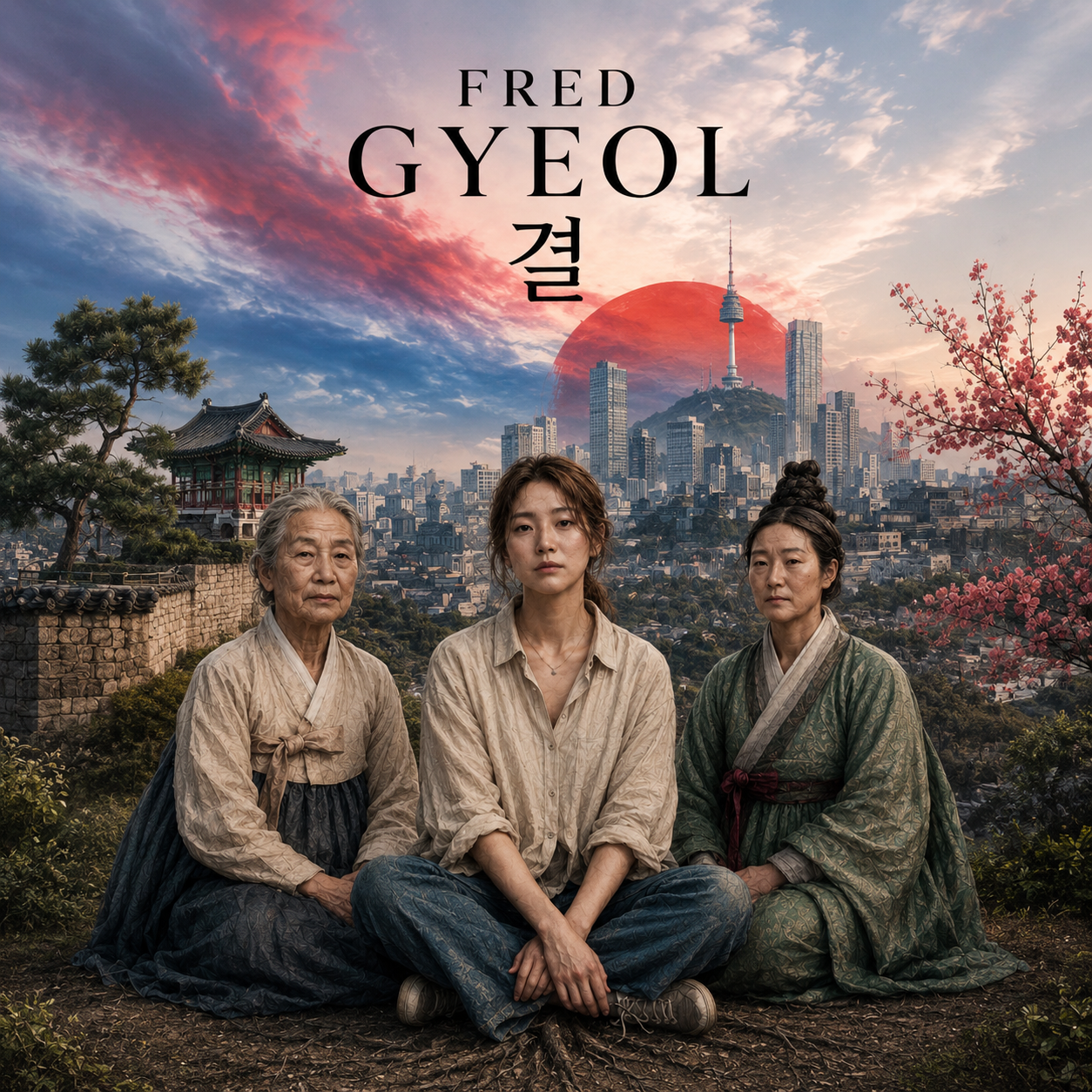
I did not come to Korea through history, geopolitics or books. I came to it much more simply, almost by chance, through images, faces and music. Jisoo was one of those first faces. At first I looked at her the way you look at something you find beautiful, without trying to go any further. Then K-pop entered my life, dramas followed, and what had begun as attraction or curiosity gradually became something deeper.
Very quickly, I became interested not only in the images themselves, but in what I thought I could sense behind them. Restraint, modesty, different ways of saying things or leaving them unsaid, an emotional intensity that did not always follow the paths I was used to. I began to understand that looking was not enough and that, if I really wanted to approach this culture, I had to accept shifting my own point of view.
That is where GYEOL — 결 came from.
GYEOL is not an album. It is a collection, designed to hold several albums and several ways of approaching Korea over time. The word evokes grain, texture, what appears when you get close enough to a material that you no longer see only its surface. That is exactly what I am looking for: not to claim to define a country or speak for the people who live there, but to look more closely, try to understand what lies beneath what I see, and accept that some things may continue to escape me.
My relationship with Korea has also been greatly enriched by human encounters and by working regularly with Koreans. Ji, Min-Ah, Kim and Ji-Ni each bring me perspectives, reactions, ways of feeling and understanding that give me much more to work with. They are not ready-made answers, but elements that help me grasp some things more clearly, discover others and often dig further into that material through song.
That does not mean I want to idealize Korea. My attachment has nothing to gain from making it perfect. The more I discover it, the more I also see its tensions, constraints, contradictions and certain aspects that can bother me. But that is precisely what makes the relationship interesting. You do not get to know someone by looking only at what you like about them; it is the same with a country. Curiosity becomes deeper when it also accepts what resists, what unsettles, or what we do not immediately understand.
The first three GYEOL titles currently visible already tell the story of that shift. Murmure de Corée is probably the most intimate: it speaks of a presence that settled in gradually, almost before I really knew what I was looking for. Viens là où bat le cœur then states something that has become essential to me: I am not here to speak for others; I am here to learn how to shift my gaze. Finally, Sous les images tells of the moment when you stop looking at a beautiful surface and begin trying to understand the layers beneath it.
These three songs are therefore not “the GYEOL album”. They are the first fragments of a collection meant to grow, with several albums, several themes and several possible paths. GYEOL must be able to evolve with what I discover, what I come to understand better, and the questions that remain open.
This approach also explains why I learned Korean. I did not do it to add another language to a list, or simply to be able to say a few stock phrases. I wanted to understand more of what happens in levels of politeness, silences, implications, imagery and ways of structuring thought. I wanted to be able, one day, to read a Korean poem and understand why it is beautiful in its own language, not only what its French translation means.
Alongside GYEOL, another collection already exists: AYA — 綾, devoted to Japan. The path is very similar, but the bond is not the same. With Korea, there is something in me that feels deeply like a love story. With Japan, it is more a very strong intellectual, historical, cultural and social curiosity, accompanied by a deep attachment, but of a different nature.
Here too, the exchanges matter enormously. Working regularly with Akiko, Yumi, Kenji and Daichi gives me perspectives, sensitivities and ways of approaching things that feed that curiosity and make me want to go further. I learned Japanese in the same spirit: not to collect one more language, but to enter more deeply into its codes, its silences, its ways of thinking and looking at the world, and one day to understand a text in its own language before turning to what a French translation can convey.
That movement is also what opened the door to AYA. Like GYEOL, AYA is a collection intended to hold several albums. For now, it remains deliberately closed because no song has yet come to give it its first voice. It will open when the right title arrives.
GYEOL, however, has already begun its journey. I do not yet know how far it will take me, or how many albums it will hold. And that is exactly as it should be.
I only know that today, when I look at Korea, I no longer want to stop at the image.
I want to get close to its texture.