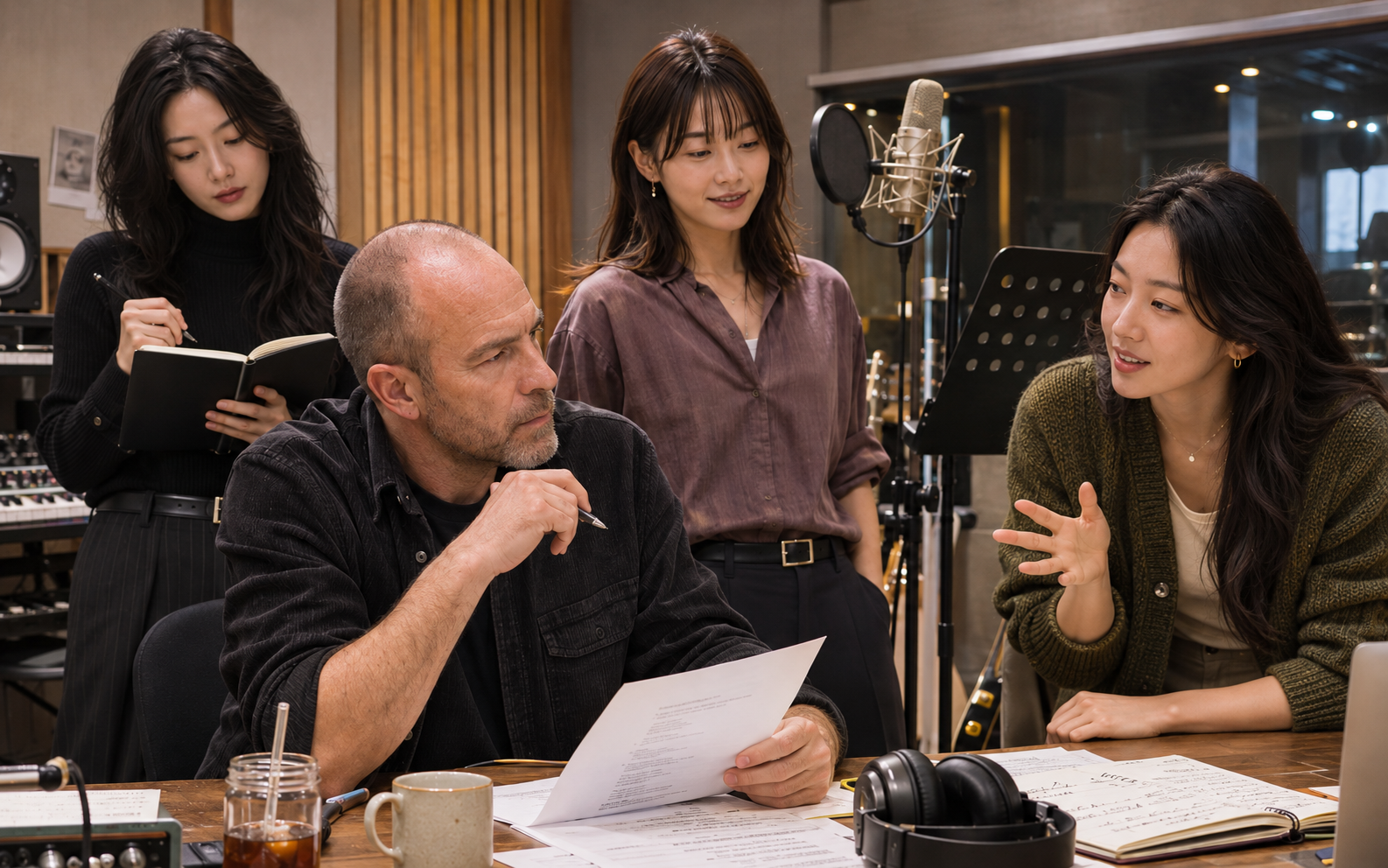
There comes a time when you look back at how far you have come and realize that the project you have been pouring your days into has grown beyond anything you imagined just a few months earlier. Yet the work goes on in almost the same way: one song at a time, one sentence at a time, with the same questions, the same standards and the same determination to find the right words. Often, it is only when you take a little distance that you can see how much has changed. Now, as November moves on and another trip to Korea approaches, I wanted to share what is really happening in our creative workshop.
The past few months have been exceptionally productive. French-language songs have multiplied, albums have taken shape, some musical worlds have grown deeper while others have begun to reveal their first notes. Some lyrics were difficult to write; some songs found their way almost immediately, while others demanded much more patience. Our repertoire has expanded considerably, sometimes faster than we expected. The FRED EP, Prière rouge and, more recently, Les veaux regardent passer le train have also marked visible milestones. But behind the releases lies a far larger body of work: finished songs, projects in preparation and artistic paths still waiting for their moment.
This creative period now allows us to announce several important milestones. Two French-language albums are complete: Le Pavé, scheduled for release on 8 January 2027, and FRED, expected on 19 March 2027. The latter will develop the world we began introducing with the EP released in October. As for CAMLAND, the five tracks of our first French-language EP are also assembled, and the artistic work is well advanced. We have not set a release date yet; we would rather allow the final preparations the time they need. These three projects show the range of our repertoire. They tell different stories and follow different musical paths, but all reflect our desire to build worlds with identities of their own.
All this activity has, however, created an imbalance. As we kept moving forward with French songwriting, we got ahead of the adaptations intended for our English-speaking, Korean and Japanese audiences. That is not bad news: it means we have created a great deal. But it also means we need to reconsider our priorities. So we have decided to devote more time to the sister works, paying particular attention to Korean and Japanese, which deserve to regain their rightful place in the repertoire's development.
This balance matters to me because our project is about much more than multiplying languages. A French song does not automatically become a Korean song just because its words have been replaced. It needs to find a natural way to breathe, to tell its story and to move people. Some images travel easily; others have to be reimagined. The music itself sometimes calls for a different phrasing, movement or shade of meaning. This work takes time, and I would rather an adaptation arrive later than lose what made the original song powerful.
We will therefore keep creating in French while making more room for those adaptations. This is not about artificially slowing inspiration or abandoning new projects. It is about preventing our catalogue from developing at different speeds. Each song should have the chance to live fully in every language, without one version being routinely sacrificed for another. That is a matter of artistic consistency, but also of respect for the people listening to us in different countries.
Since our return from Korea in August, September and October have been two particularly intense months. The workshop has barely had a moment to rest. Akiko, Min Ah and Yerin have come and gone as their travel, other commitments and opportunities to work together allowed. Every Wednesday and every weekend, studio sessions followed one another. Behind those appointments are hours of listening, rehearsing and discussion, sometimes spent correcting details that may seem tiny but can change the entire colour of a song. We may need to record a performance again, find the right balance between voices, adjust an arrangement, revisit an adaptation or simply let an idea mature before deciding it is ready. That steady work, often invisible to the audience, is an essential part of what we are building.
Of course, none of this happens alone. Month by month, FRED has grown into a collective adventure shaped by different sensibilities, experiences and cultures. Behind one song there may be long conversations about an image, an intention, a phrase that does not sound natural in another language or an emotion that proves difficult to recapture. Everyone brings their own way of hearing things, sometimes their disagreements and often their instincts. I truly believe that this diversity has become one of our greatest strengths. It pushes us beyond our habits and asks us to see our songs from more than one perspective.
And then there is Korea.
Next week, I will travel once again to South Korea for a particularly important moment in our story: the signing of a professional agreement that should open a new chapter for FRED MUSIC in Asia. This is not another initial meeting or merely an opportunity to explore possibilities. It is the culmination of discussions and work that have been underway for some time. At the moment I am writing, the agreement has not yet been signed, but we are preparing to take that step.
I am fully aware of what this moment represents. Until now, we have built most of our development through our own resources, a great deal of work and the determination of an entire team. A professional partner in Korea should help us approach our presence in Asia differently, particularly in South Korea and Japan. It offers the prospect of new support and resources without erasing what we have already built. I will not announce outcomes today that still belong to tomorrow, but I can tell you that this signing marks a major milestone in the life of FRED MUSIC.
I also had one principle to defend throughout this process: FRED must not become a solo venture at the expense of the collective. From the beginning, people have given their time, energy, ideas and part of themselves to help this project grow. It was essential to me that our shared history be respected. Behind the name FRED are, of course, my lyrics and my songs, but also those who give them another life. We have made this journey together, and together is how I want to continue.
Nor does this new Asian chapter mean we are turning away from French. I am deeply attached to the language. French remains the starting point of my writing, the language in which my images, anger, tenderness and contradictions first emerge. If our songs then find another life in Korean, Japanese or English, I see that as another opportunity to share them, not a reason to abandon their origins. We want to build bridges between these worlds, not choose one audience over another.
We are also thinking about new ways to invite you into our work and show you what happens between writing a song and seeing it reborn in another language. Some of these ideas still need to take shape, but they reflect a growing wish among us: not only to let you hear the music, but also to share part of the journey that brought it into being.
So yes, there is still an enormous amount to do. Adaptations to finish, albums to build, songs to revisit, new musical territories to explore and meetings yet to come. I do not see that list as a race against the clock. I see it as the privilege of still having so much to say, and the chance to bring those stories to life with people who share this adventure.
When I leave for Korea, I will take many projects with me, but also the whole journey we have travelled so far. I will think of the lyrics that began as words on a page, the songs that eventually found their audience, the people who joined the workshop and those who have followed us from the earliest days. A signature does not replace all that work. It simply opens new possibilities for it.
Thank you for continuing to be part of this journey. The story of FRED MUSIC still has many songs left to tell.
FRED