On 2 August, Fred and I left Paris for Japan. The following day, we arrived in Kanazawa, where Yumi Saitō, his stage-expression coach, lives. By 4 August, the whole team had joined us. This time, truly the whole team: vocalists, musicians, sound engineers and the people surrounding the project. We had already met twice in France, but never before in this complete configuration.
And something changed in Kanazawa.
There was, of course, work. A lot of work. But it would be difficult to say exactly when we were working and when we had stopped. Conversations carried on over meals, in the street, in the evening, sometimes very late into the night. We could be joking, talking about something completely different, and then someone would suddenly say, “What if we tried this?” One idea led to another, someone picked it up, and off we went again.
We slept very little.
I had prepared the trip as carefully as I could. I quickly discovered that organising a team in full creative effervescence can sometimes feel like a balancing act. Everything was happening at once. The challenge was to keep a direction without breaking the energy. It was playful, sometimes frankly chaotic, but also incredibly studious.
Fred, above all, became aware of what the team had become. For the first time, he could look around and see the entire group together, musicians included. Some already have real stage experience; some could choose other artistic projects that are further established. And yet they are here. They believe in this project, they love what they do in it, and they choose to keep going.
“In Kanazawa, I realised we were no longer just a team. We had become a family.”
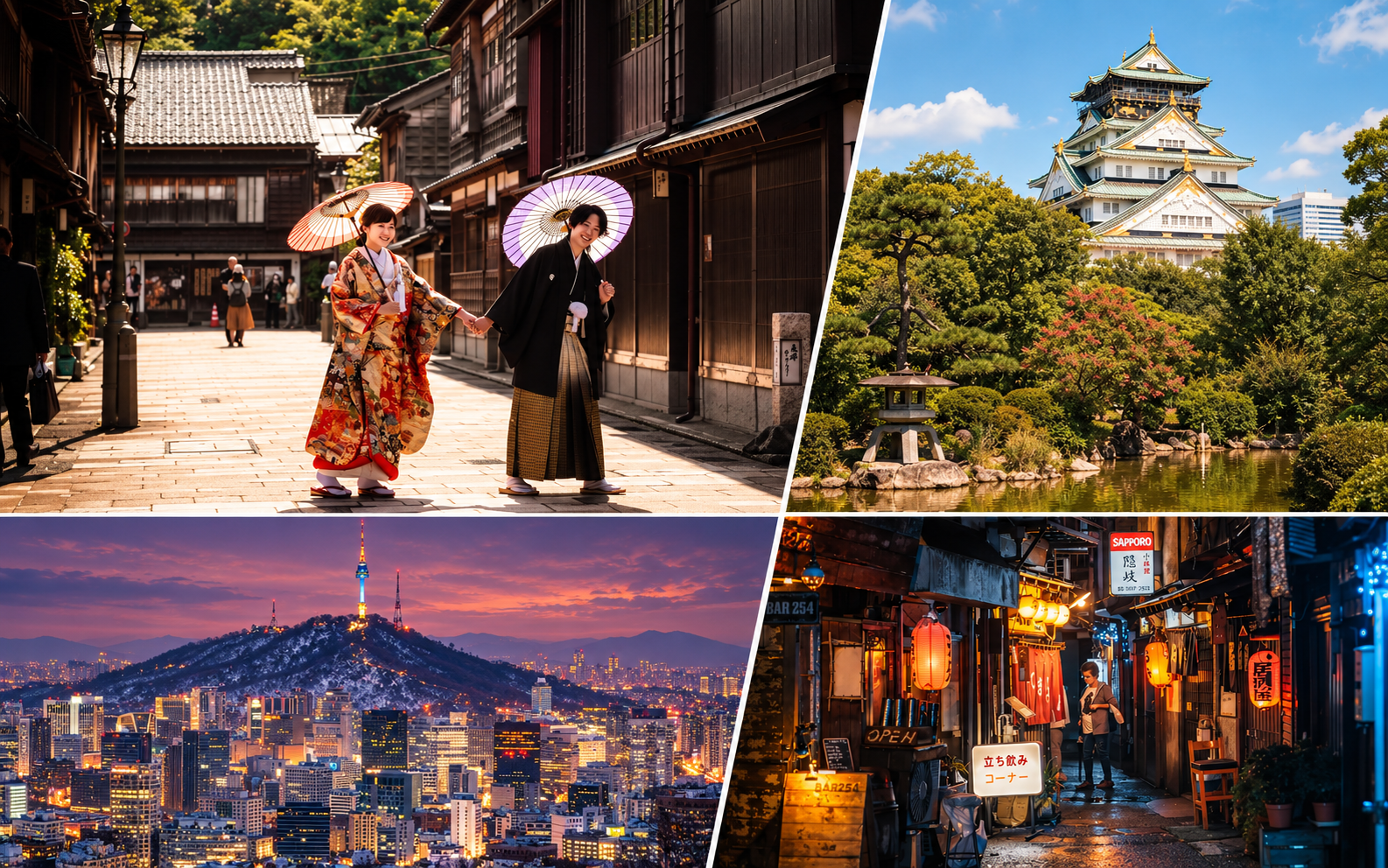
A note about the images accompanying this article: out of respect for the private individuals we met or who were present during the trip, we chose not to publish any personal photographs. There is also a much more prosaic reason: Fred lost his phone, along with all the photos he had taken throughout the journey. The images used here therefore simply show some of the places that marked our route.
Kanazawa, or learning to look
Fred liked Kanazawa immediately. He found a scale there that felt more human to him than Tokyo or, later, Seoul. The historic districts, the museums, the streets and the city itself left him with a wealth of images.
But the encounters mattered just as much. He met Yumi’s family, as he would meet several families of Japanese members of the team over the course of the trip. One comment touched him especially: French-speaking artists naturally come to Japan with their French songs. FRED’s approach is different. The repertoire is born in French, but when it moves towards Japanese or Korean, the aim is not simply to translate lyrics. The question is how the same emotional core can live in another language and another culture.
Fred often replied that there would inevitably be awkwardness and imperfections. He is neither Japanese nor Korean and does not pretend to be. Curiously, several people found precisely that openly accepted limitation authentic. The point is not to hide the person who writes, but to move towards others with enough respect to accept that everything cannot remain exactly as it was in the original French song.
Japan as a whole fed that feeling. Kanazawa, Tokyo, Kyoto, then Osaka before leaving for Korea. Streets, smells, sounds, everyday scenes, tiny things that may not immediately be recognisable in a song. Fred prefers to call them seeds. Some may germinate in a few weeks, others perhaps years from now.
Osaka also left a very strong impression. In some respects Fred preferred it to Tokyo: still immense to European eyes, but more accessible, very lively, full of shopping streets and, above all, remarkably effective at making any reasonable notion of dietary moderation disappear. On that point, nobody in the team showed much discipline.
Two encounters to begin understanding the stage
The Japanese leg also included two concert-encounters in French cultural centres, one in Tokyo and the other in Kansai, near Kyoto. Around a hundred people attended each event, mainly students learning French at school, high school, university or through courses offered by the centres.
We had prepared around ten songs for each meeting, with a different programme in each place. Fred sang some titles alone; Min-Ah Seo and Akiko Tanaka joined him for songs designed as duets. The other vocalists, backing voices and musicians were there as well.
For Fred, these two dates were above all his first real confrontation with an audience. He has never hidden the fact that the stage makes him uncomfortable. These encounters helped him find his bearings, but also understand that the classic form of a singer standing alone in front of a room may not be what suits him best in the long term.
The conversations with the students were probably as important as the concerts themselves. Some were immediately curious. Others later admitted that they had been more doubtful at first. Then, as we explained the project — why the songs are adapted, why certain images or references may change, why a sister work is not a literal translation — their perception shifted.
Fred came away with a simple impression: when the approach is explained sincerely, something opens.
Several students spoke about authenticity. Some told him directly that he “sang truthfully”. That expression touched him deeply.
Akiko created another kind of surprise. Her spoken French is still hesitant, and in ordinary conversation some students sometimes handled it better than she did. Then she began to sing. Her pronunciation became almost accent-free. The contrast astonished the audience.
It says a great deal about the way she works: she enters the emotion of a song first, searches for what it has to carry, and then places the words inside that emotion.
Those encounters also created lasting ties. Among the people Fred met in Japan, he still regularly exchanges messages with several dozen of them. They ask for news, follow the project, visit the website and come back to talk.
And that was only the beginning.
Seoul: another change of scale
We left Japan on 12 August, after passing through Osaka, and headed for Korea.
This part of the trip had been prepared for several months. Through a number of connections around the team, we were already in contact with a major Korean-Japanese label. Masters had been sent before our departure, the project had been presented, and several exchanges had already taken place.
I prefer not to name that partner today. The discussions are serious, but they are still ongoing and some details remain to be settled.
The partner made its studios available to us during the stay and had also organised a concert in Seoul. A more formal meeting with its management was planned for the end of our time in Korea.
That immediately gave this part of the journey another dimension.
Around twenty tracks in the Seoul studios
The studios themselves impressed Fred.
Not because studio work was new to him: we are already fortunate to work regularly in good conditions in France, and the team has its habits with Kenji and Daichi. What struck him was rather the weight of the place itself.
Walking into the facilities of a major label, knowing which groups and singers had worked in those same rooms, looking around and wondering, “What am I doing here? Do I really belong here?”
The work itself quickly became very concrete again.
We returned to around twenty tracks that already existed as demos or advanced versions. Several FRED universes were involved. Depending on their state, the tracks were worked on, finalised, recorded or mastered.
One point mattered especially to us: continuing to work with Kenji and Daichi. Even in the label’s studios, we were able to retain our way of working and our own sound engineers. If the current discussions were to lead somewhere, that continuity would remain important.
The days usually began around 9 a.m. and continued until 3 or 4 p.m.
Then another part of the stay began.
When the others discover Seoul
For me, Korea was obviously not a country to discover. The pleasure came instead from watching Fred and part of the team move through it, react, compare, be surprised, and sometimes stop in front of things that I no longer necessarily saw in the same way.
After the studio days, we went out. A lot.
Seoul has a way of making you forget the time. Evenings often stretched to midnight, one or two in the morning, sometimes later. Fred threw himself enthusiastically into the street food, restaurants, streets, neighbourhoods and nightlife. He also discovered that it is perfectly possible to work seriously all day and then destroy, within a few hours, any reasonable prospect of sleep.
We ate a lot.
We also drank a lot.
Sometimes you have to remain honest in a section called Behind the scenes.
Sundays, when there was no studio work, allowed us to go further afield, get out of Seoul more, and take the time to look around.
The fatigue was building, but while we were there it was almost invisible. Excitement served as fuel.
One night at Namsan
Of all the images of Seoul, there is one that I believe cannot be separated from this journey.
One night, we went up to Namsan Tower.
The city stretched below us. Fred stood there for a while looking down over Seoul, then turned towards Min-Ah and me.
“I feel as if I’m at home. I feel as if I belong here.”
Min-Ah started to cry.
There was nothing to add.
The sentence came out spontaneously, and it probably sums up better than any analysis what happened between Fred and Korea during this stay.
He already loved the country deeply before arriving. But he found something there that was different from the fascination he feels for Japan.
In Japan, he loves the history, the contrasts, the way the country can move from the highly codified to the unexpected, sometimes even the improbable. That also speaks to a part of his own personality. Japan feeds his curiosity and imagination.
With Korea, the feeling is harder to explain.
He speaks of a kind of familiarity.
Not an imagined belonging, still less a claim to be something he is not. Simply the feeling that certain ways of being, certain relationships and certain ways of letting distance fall away once trust has settled correspond to something deep inside him.
He once told me that Japan feels to him like a first love, while Korea gives him more the feeling of encountering something that could accompany an entire lifetime.
That image should be taken for what it is: not a ranking between two countries, but two different ways of being touched.
Then came the concert
The Korean-Japanese label had also organised a concert during our stay.
Fred knew he was going to sing. What he did not know was how brutal the change of scale would be.
After the Japanese encounters in front of around a hundred people, he was still imagining something fairly intimate.
When he entered the venue, he discovered around 3,500 people in front of him, in a hall that could hold roughly 4,000.
A hundred people had already demanded a lot from him. This was another world.
The strongest moment came during the Korean version of Prière rouge. Two large side screens displayed the lyrics so the audience could follow and join in.
Fred began to sing.
Then the chorus arrived.
And the room took it up.
Several thousand voices at once.
Fred stopped.
Not because he had forgotten the words. Because the emotion had quite literally overwhelmed him.
He tried to start again. The audience started again with him. The emotion returned immediately. He was crying and could barely sing.
Min-Ah, drawing in particular on her past experience as a trainee, took over and carried much of the end of the song.
The audience could have waited for him to recover.
They did exactly the opposite.
They kept singing.
As if to carry him.
Later, with her usual directness, Yumi made it clear that there was still a great deal of work to do on managing that emotion on stage.
She was right.
But it was also from that moment that our thinking about a future stage format began to make much more sense.
Another way of imagining the stage
The Japanese encounters had already allowed us to experiment with large lyric screens so that the audience could sing along.
Seoul confirmed how powerful that idea could be.
The thinking is still open today, but a direction is beginning to emerge: Fred alone at the front of a fairly stripped-back stage, two large side screens allowing the audience to follow the lyrics and participate, and perhaps one day a large central screen using filmed or metaphorical images to accompany the songs.
The exact form does not exist yet.
Nor do the necessary means.
But the idea came from a real experience: when several thousand people begin to sing, the audience is no longer merely watching the show. It enters it.
And for someone like Fred, whose own songs can sometimes trigger emotion that is difficult to control, we will also have to invent a way of preserving that intensity without allowing it to prevent him from continuing.
The Seoul concert did not really end with the final song either.
Nothing had been organised afterwards. And yet several hundred people stayed — around 300 to 400, by our estimate.
For another hour and a half or two hours, we talked. Some people came towards the stage, we went into the audience, microphones moved around, and so did the questions.
After 3,500 people, everything ended, almost paradoxically, with something much simpler: people who simply wanted to stay and talk.
Why is something happening there?
That concert is obviously not an answer on its own.
But it adds to something Fred had already noticed: today the project receives much more response in Japan and Korea than it does in France or more broadly in the West.
He does not claim to know exactly why.
One hypothesis comes up often, however. In France, FRED is one independent music project among thousands. In Japan and Korea, the approach seems more unusual: a French-speaking writer arrives with his own repertoire but accepts that his texts need to be reworked in order to seek a genuine encounter with the languages and cultures he is addressing.
That arouses curiosity.
Sometimes it first creates reserve.
Then, once the project is explained, that reserve can disappear very quickly.
The contacts that multiplied after Seoul, like those that already existed in Japan, also influenced one very concrete decision: turning the FRED website into a genuinely four-language space.
French remains the matrix language. English naturally opens the project to a broader international audience. But it had become inconsistent to ask Japanese or Korean people to take an interest in the project without offering them a complete point of entry in their own language.
Japanese and Korean are therefore not decorative additions to the website.
They correspond to real people.
Meeting the label
Towards the end of the stay came the more formal meeting with the label that had welcomed us into its studios and organised the concert.
I had handled much of the preparatory work. Other members of the team had also made that introduction possible through their own professional histories.
Fred experienced the day in a rather particular way.
He felt as if he were sitting an exam.
A first contact, then a manager, then another, all the way to the label’s management. At each stage, he almost felt as if he had earned the right to move on to the next one.
Min-Ah and I explained afterwards that there was nothing particularly unusual about that way of proceeding in this context.
The final reception was very positive.
I will not go into the content of negotiations that belong to us and are not yet complete.
What matters lies elsewhere: what interests our interlocutors is precisely the project’s approach. They know few examples of French-speaking writers systematically developing their own works towards Japanese and Korean through genuine cultural adaptation.
Nobody promised us a fairy tale.
The road would probably be long. Difficult. Full of obstacles. Fred’s age does not necessarily make certain things easier in an industry that often loves youth.
But, in their view, the adventure is worth attempting.
That fits rather well with what Fred has said from the beginning.
“I want to go all the way with what I started. Write what I have to write and put down what I have to put down. After that, whatever happens, happens.”
Fame is not his main driving force. Being able to live entirely from music would of course be extraordinary. But when he talks about success, he very quickly talks about the others.
Those who are younger than he is.
Those who chose this adventure.
Those who stay even though they could sometimes go elsewhere.
He would like FRED, one day, to become something sustainable for them as well.
Busan, with Min-Ah as our guide
The final three days took us to Busan.
There I was very happy to hand over the role of guide to Min-Ah.
She is deeply attached to her city and set about telling us its history with enough enthusiasm that, according to Fred, we are now all capable of sitting an exam on Busan.
He is exaggerating.
A little.
He loved the city. Huge by European standards, but more breathable to him than Seoul or Tokyo, with the sea, the beaches and a different atmosphere.
He also had the chance to spend a day with Min-Ah’s family. That part of the trip will deliberately remain in the personal sphere. It is enough to say that he keeps an especially warm memory of it.
We did not really come home
On 31 August, we returned to France.
The real fatigue was waiting for us here.
The time difference, the accumulated lack of sleep, the weeks spent working by day and still living through much of the night finally caught up with us.
But there was no grand airport farewell scene.
We came back together.
And as I write these lines, we are gathered again in France for our regular week of work together.
The team has worked this way for some time now: periods when we are all physically together, followed by a daily life conducted at a distance. Today’s tools allow group video calls, targeted sessions, vocal work, remote recording and almost continuous exchanges between France, Japan and Korea.
The real adversary is mainly the time zone.
Sometimes Fred works at night in order to connect with someone in Asia; sometimes it is the other way around. Part of my job consists precisely in making all of that fit into schedules that remain vaguely compatible with human life.
So we did not really return from the journey in order to stop something.
We simply changed location.
What remains
Around twenty tracks remain that passed through the Seoul studios.
Two first public experiences in Japan remain.
A room of 3,500 people remains, and a chorus of Prière rouge that Fred could not finish because the audience was singing with him.
A new way of thinking about the stage remains, and about the place the audience might take within it.
There are encounters, professional discussions still open, Japanese and Korean correspondents, and a website that became four-language because those languages now correspond to very real people.
There are also streets, museums, beaches, meals, nights that were too short, sounds, smells, and countless seeds whose future songs we cannot yet know.
And then two sentences remain.
In Kanazawa, Fred looked at the complete team and thought:
“We are a family.”
In Seoul, from Namsan, he looked over the city and told us:
“I feel at home here.”
Perhaps this journey simply fits between those two sentences.