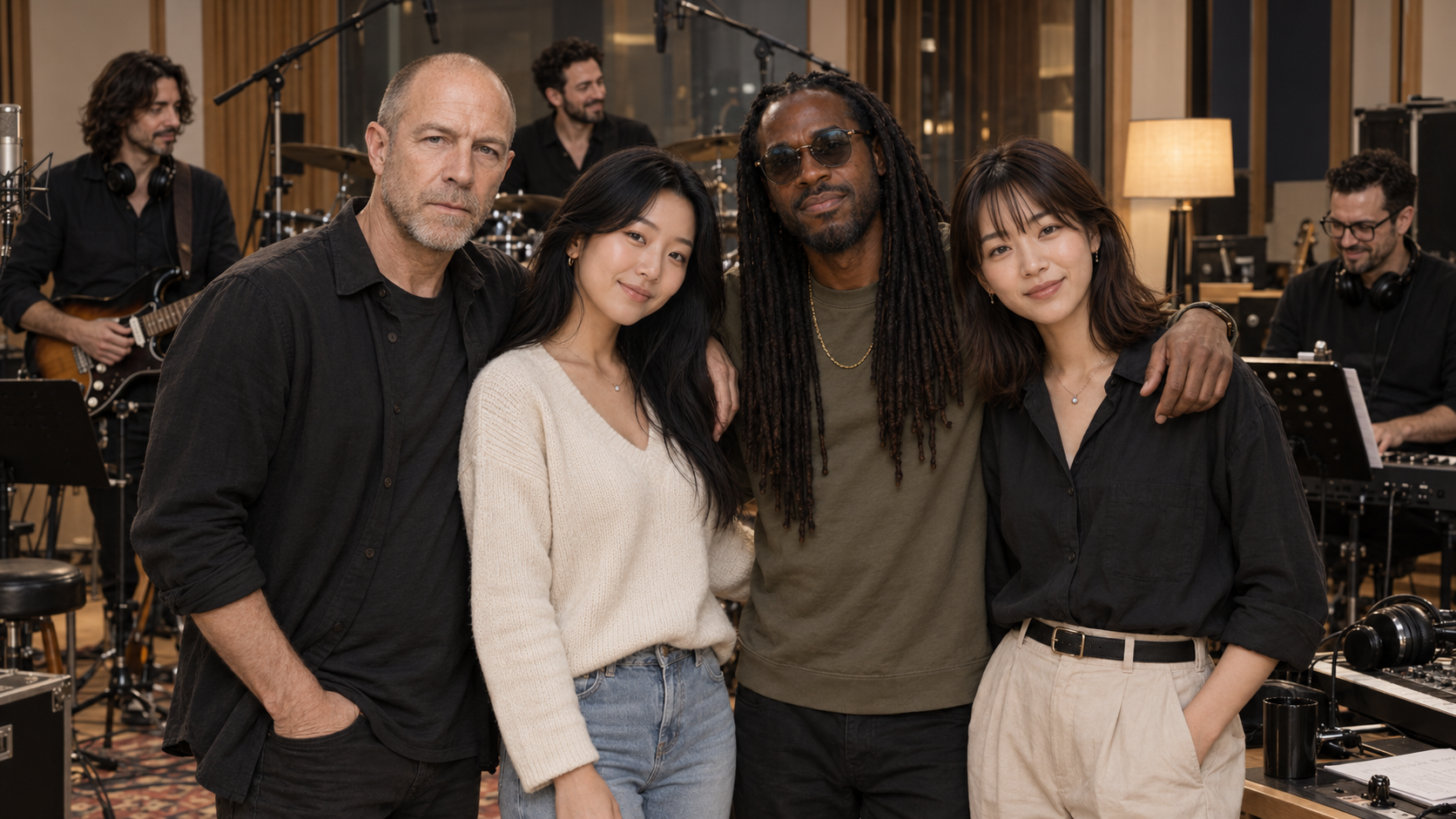
There are periods when it becomes difficult to tell where work ends and everything else begins. The past few weeks have been exactly like that.
The bonds that exist within the team today were not created during our trip to Japan and Korea. We already knew one another, had met several times and had worked together before. But the journey deepened those ties, and in a way it never really ended when we came home.
For some of us, this shared way of living had already begun in August. After Japan and Korea, part of the team stayed with Fred, another part with me, while others returned home but remained fully involved in the work. We kept moving between small groups, video calls, full-team sessions and separate working blocks until we reached the studio week in Paris that had been planned for a long time.
So it was never really a one-week interlude. It was more the high point of several weeks in which we had lived and worked together intensely. A strange little temporary community took shape, with everything that comes with it: conversations, laughter, ideas arriving at the wrong moment and, to be honest, conditions that were not always ideal for the sound engineers.
Daichi and Kenji probably discovered a new definition of the word “patience”. Between people talking, moving from one room to another, working nearby and forgetting at exactly the wrong moment that a take was being recorded, finding a few minutes of absolute silence could become a genuine achievement. Their despair was, naturally, very entertaining to everyone else. Perhaps slightly less so to them.
A lot of work. Really a lot.
Behind the cheerful disorder, we worked enormously hard. The Paris studio week was especially intense: most days started around 8:30 in the morning and, depending on the day, ended at six, eight, ten or sometimes even eleven at night.
The results are tangible. The first Le Pavé album is now almost entirely complete. The FRED EP is fully finished and moving toward release. Several adaptations progressed, masters were completed, visuals prepared, new ideas emerged and some future projects began to take on a much more concrete shape.
But what stays with me even more than the quantity of work is the way it happened. Something between us has become remarkably fluid.
Fred can arrive with one verse, perhaps two, still rough. A musician picks up the idea, a few notes appear, someone tries a melodic line, a voice joins in, someone else suggests slowing down, shifting an accent or simply letting a word breathe. Then, without anyone really deciding when it happened, something that did not exist ten minutes earlier begins to become a song.
We experienced several moments like that, and they probably say more than anything else about what is settling into place. From the outside, it may not look spectacular. But for a creative team, beginning to understand where another person is going without needing long explanations is one of the most valuable things that can happen.
Voices learning where they can meet
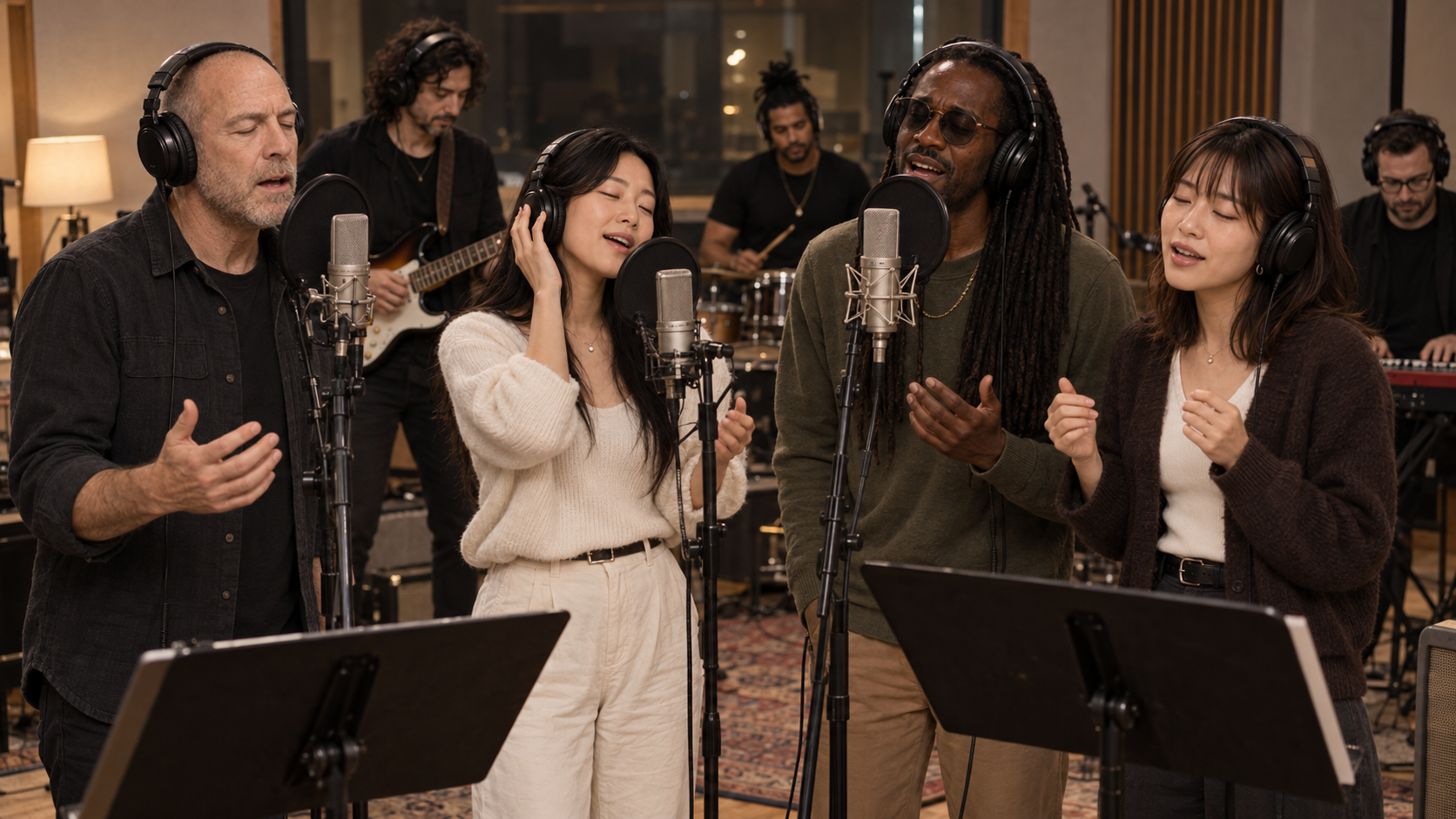
That fluidity is not accidental. It is also the result of real work, especially with the voices.
The closeness between Fred and Min-Ah has become obvious on a human level, enough to feed the group’s jokes on a regular basis. But something else has developed between them as well: a genuine artistic and vocal connection.
Ji-Ni and Kim, our vocal coaches, have worked a great deal on that point. The goal was never to push either of them into a range that does not naturally belong to them. It was to identify the places where their voices can actually meet.
Those meeting points now exist.
When Fred reaches the upper end of what he can sing comfortably, Min-Ah can take over. At other moments, their ranges overlap enough for them to play with that junction, answer each other or pass a line naturally from one voice to the other. The result can be surprisingly effective precisely because their voices are not alike.
The whole point is to find the exact place where two different vocal identities can touch without either singer having to force anything.
The same work has been done with Akiko and is beginning to bear fruit there too. It is no longer just something explored in rehearsal: the masters completed during this period show it clearly. Very little corrective work was needed after the takes, because the voices are beginning to find their intersections for real.
That is an important development, and certainly one of the things that excites us most.
No one is confined to a job title
You can see the same way of working elsewhere in the team, and Kenji and Daichi are a perfect example.
Fred has grown much closer to both of them over the past few weeks. They speak about Japan with an infectious passion. They tell stories, explain things, correct assumptions, point out details we might never have noticed, and all of that feeds directly into the creative process.
The future Aya project, devoted to Japan, is already benefiting enormously from those conversations.
Kenji and Daichi are sound engineers, but that does not keep them outside the artistic discussion. Quite the opposite. Their memories, references and perspective bring in material, trigger new ideas and sometimes force us to look at a direction differently.
That may be one of the things I like most about this group: roles exist, of course, but they never become walls. A musician can bring in a lyrical idea, a sound engineer can feed an artistic universe, a singer can suggest a musical direction. Everything circulates.
And then there are the silly moments
Because a team that spends this much time together inevitably develops its own running jokes, and Malik is probably responsible for a fair number of them.
Among other things, we discovered that he can produce an impressive range of sounds with his voice. His love of reggae gave us several memorable parodies, soon followed by rap, ragga and a few things that were much harder to classify.
He has also decided to learn Japanese, a project Akiko observes with only limited mercy. At one point she borrowed one of Fred’s expressions to describe his current level: something along the lines of “speaking Japanese like a Spanish cow” — or perhaps an African one. Nobody remembers the exact version anymore, but everybody remembers laughing very hard.
Malik also appointed himself priest for the day.
To understand why, we have to go back to our time in Korea. Fred spent a full day in Busan at Min-Ah’s parents’ home, with her and her family. It meant a great deal to him and already showed how much trust had developed between them.
That was more than enough for Malik. In his version of events, Fred had met the parents and spent the day with the family, so “parental approval” had officially been granted. Since Fred and Min-Ah’s closeness was already a regular source of teasing, Malik decided every condition had been met and proceeded to marry them with approximately the level of solemnity you would expect.
Nobody asked for a certificate.
Akiko, meanwhile, acquired another unofficial title: Fred’s “Japanese daughter”. Again, the nickname grew out of the very visible affection between them and slipped almost naturally into the group’s vocabulary.
It is childish, obviously. And thank goodness for that, because those small jokes also say a great deal about the trust that has developed.
Akiko only wanted a drink
Some jokes, however, are born entirely by accident.
One evening, while we were walking through Paris, Akiko spotted a place that looked friendly and suggested we go in for a drink. She had missed one small detail: it was not really a bar.
It was a swingers’ club.
Once we realised where she was unintentionally trying to lead us and explained what the place actually was, Akiko turned bright red. Properly, spectacularly red.
She was so embarrassed that, naturally, nobody had the decency to change the subject. For the rest of the evening she was officially the person attempting to corrupt and lead the entire team astray.
She protested with great energy, which of course only made her case worse.
Looking for Korea in Paris
Another evening took us to what presented itself as a Korean restaurant. On paper, the idea sounded excellent. Once the food arrived, Min-Ah and I had a few doubts.
Quite a few, in fact.
The place was run by Chinese owners and the food had, let us say, a rather distant relationship with what Min-Ah and I recognised as Korean cooking. There were references, certainly — from a distance, with a little goodwill.
At least the evening gave us a long conversation about what happens to food when it travels, adapts, mixes with other cuisines and sometimes ends up only vaguely resembling what it claims to be. More importantly, it made us laugh a great deal.
Working together, but also learning each other
Over the course of these weeks, relationships naturally changed.
Min-Ah and Fred have become very close. You can see it as people; now you can also begin to hear it artistically.
Fred has grown much closer to Kenji and Daichi. Akiko, with her energy and curiosity, has found her place in this odd little artistic family. The singers, musicians and technicians know each other better and are starting to anticipate one another’s reactions. We know who will defend an idea to the end, who will make a joke at the worst possible moment and who will eventually beg for five minutes of silence so something can actually be recorded properly.
And then there is Fred and me.
Our working relationship is not new either, but I think the team now understands very clearly how we function. Fred thinks quickly, constantly and sometimes in several directions at once. His ideas often arrive before they have had time to organise themselves.
My role is often to catch them as they pass, work out which ones can live together, which ones need to wait and how all of it can become a coherent artistic direction.
He calls that being more “square”.
I could choose other words, but he is not entirely wrong.
We work very closely, with a closeness of work, mind and heart that often brings us to the same conclusion by two different routes. The team has understood that perfectly: we are moving in the same direction.
That trust makes everything else considerably easier.
Paris after the studio
After ten or twelve hours of work, the reasonable thing would obviously have been to go home and sleep.
We sometimes tried.
Then we had to eat, and once we were outside, Paris tended to take care of the rest.
We used those evenings to walk, discover less obvious places and get as far as possible from the postcard version of the city. Min-Ah fell in love with Montmartre, while Akiko would probably have camped at Les Invalides if we had allowed her.
Watching them discover parts of Paris with that mix of curiosity, surprise and delight became part of the pleasure too.
Not every evening was quite so sensible, however.
One of them ended at my place much, much later than planned. Claire, in an exceptionally cheerful mood after a few drinks, ended up standing on a table singing Patricia Kaas. Malik joined her. Then Antoine.
At half past five in the morning, we therefore had three people standing on a table turned into an improvised stage, performing Patricia Kaas with admirable conviction and considerably less admirable discretion.
Eventually a neighbour knocked on the door and asked whether we might, perhaps, consider making a little less noise.
I have to admit I was fairly embarrassed. At 5:30 in the morning it was becoming difficult to explain with a straight face that this was a work meeting.
Looking back, I am even surprised that my husband did not come and protest long before the neighbour did, since he had to work the next day. I suppose he deserves a special mention for services rendered to the project as well.
So we finally turned the volume down.
It was time.
The house is quieter now
Today everyone has gone home, and neither Min-Ah nor Akiko seemed particularly eager to leave. I do not think any of us really wanted this period to end.
We had to remind them that it was not really a separation. There are still video calls, vocal takes, recordings, songs to continue, adaptations and all those projects that will keep moving between France, Korea and Japan until we are physically together again at the end of November.
Of course we can look at what has been produced over these past weeks: finished songs, projects moving forward, studio hours, new ideas and everything that will gradually find its place in the months ahead.
But perhaps that is not the most important part.
The most important part is much harder to measure.
We were already a team before we left. We did not suddenly become close because of one trip; we already knew each other. What happened is simply that several weeks spent almost constantly together deepened something that was already there.
And somewhere between a take ruined by too much noise, two voices learning how to meet, a melody found almost by accident, Malik’s impressions, a fake wedding, a fake Korean restaurant, Akiko standing outside a swingers’ club and Patricia Kaas being sung far too loudly at half past five in the morning, we learned a little more about how to work together, understand one another, trust one another and, above all, laugh a lot.
You cannot schedule that kind of thing on a calendar.
And that is probably why it matters so much.