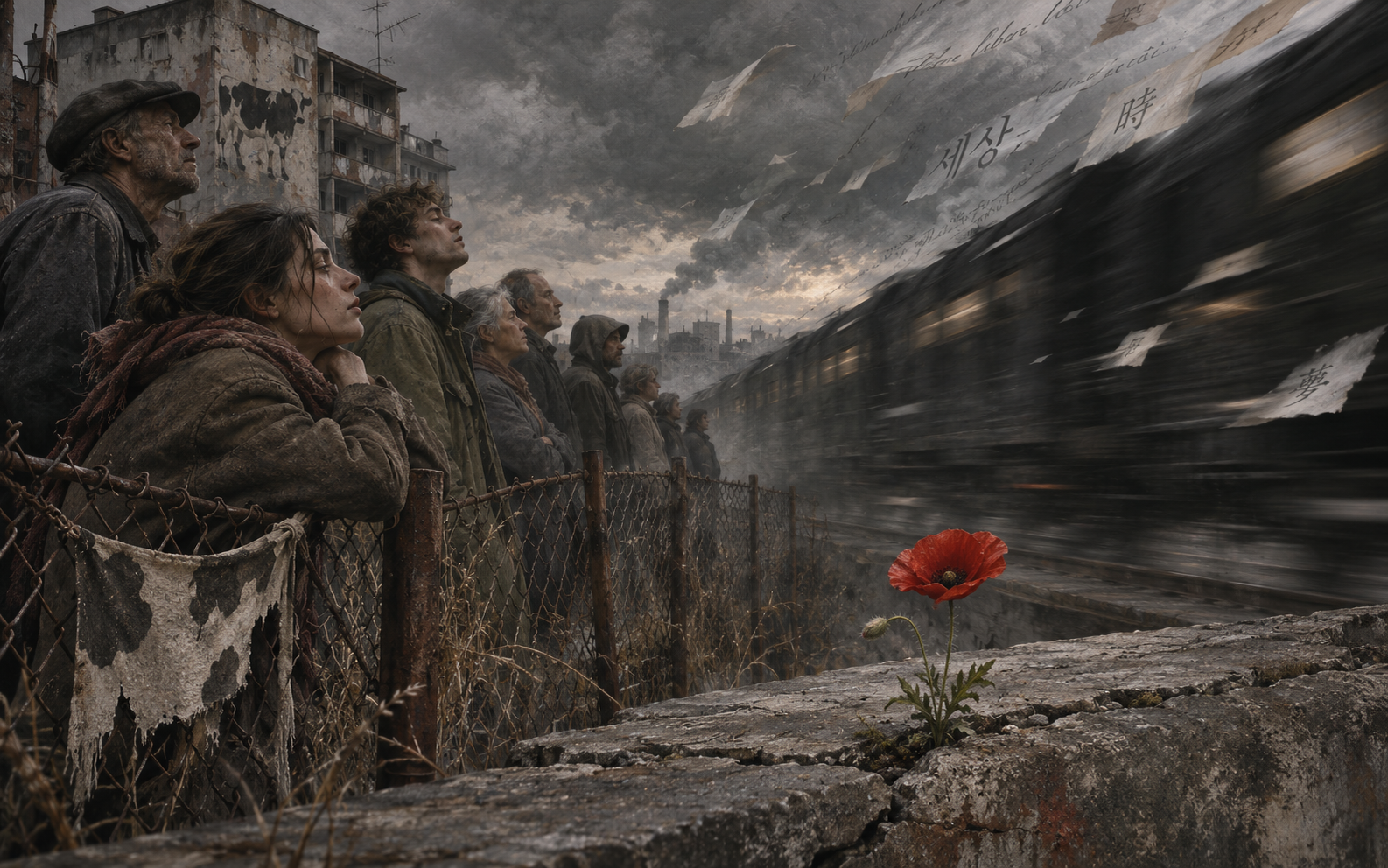
Some songs try to comfort us. Others tell a story or invite us to see the world differently. And then there are songs that simply refuse to leave us in peace. Les veaux regardent passer le train, released on 6 November 2026, firmly belongs to that last group. In the world FRED calls Le Pavé, words aren't always meant to soothe. They can unsettle, provoke, shake our convictions and remind us that silence, once it becomes a habit, isn't necessarily a sign of wisdom.
The title itself sets the tone. The calves watching the train go by aren't innocent creatures discovering dangers they never knew existed. They see, they understand, sometimes they comment, and then they carry on with their lives. The song attacks a particular kind of surrender: recognizing injustice while refusing to accept the consequences of doing anything about it. It's more than indifference. It's that strange human ability to grow accustomed to things that should have sparked outrage.
FRED doesn't describe this passivity gently. The images pile up, the language grows sharper, and the lyrics gradually build a suffocating mechanism. The drawing-room version of truth, “rented anger”, indignation that lasts only an instant: these images expose a society in which reacting sometimes takes the place of acting. The music follows that movement without making it comfortable. The voice hovers between singing and declamation, while the tension rises until the final seconds leave behind an almost ghostly sonic trail. The train has passed, yet its passage still echoes.
The song perfectly illustrates one of the hallmarks of Le Pavé: its roots in a French language rich in everyday expressions, irony, implication and shared cultural references. That's also what makes this musical world so difficult to carry across borders.
Because sooner or later a question arises: how can you convey that kind of anger to someone who doesn't share your mother tongue, or necessarily the same cultural references?
Consider the image of the calf. In French, it can immediately suggest docility, herd behaviour, a lack of independent thought or collective submission. But translating that image literally into Korean or Japanese offers no guarantee that it will provoke the same reaction. Readers may understand the animal perfectly well without sensing all the satirical violence FRED has placed behind it. The challenge isn't simply finding the right word; it's recovering the emotional and symbolic weight that word carries.
The difficulty grows when several images overlap. An expression such as “dignité de prairie” — literally, “pasture dignity” — isn't merely descriptive. It combines a fundamental human quality with an animal, pastoral world to create a particularly cruel irony. A literal translation could preserve the words while losing their purpose. But systematically replacing French imagery with local equivalents might erase part of the work's personality. Real adaptation takes place in precisely that space between faithfulness and reinvention.
Korean and Japanese each bring their own demands. Their grammar, levels of formality, ways of expressing criticism and rhythmic possibilities don't naturally line up with French. A short, brutal phrase that works perfectly in its original language may become long, awkward or less powerful when transferred. We then have to decide what absolutely must survive: the image, the rhythm, the irony, the shock or the deeper intention. These elements can't always be preserved at the same time, and every choice shapes part of the song's identity.
Historical references pose another challenge, especially in the social and political territory explored by Le Pavé. An allusion may awaken in a French listener a shared memory, a tradition of protest or a familiar picture of authority. That same reference won't necessarily carry the same associations in Seoul or Tokyo. National histories differ, as do the wounds they leave behind, and political symbols don't resonate everywhere in the same way. But it would be wrong to assume that such differences prevent works from connecting with people. They simply demand more precision, sensitivity and, at times, imagination.
That's why our work isn't about making FRED's songs more polite when they leave French behind. We don't want to soften their irony, neutralize their anger or smooth away their individuality just to make them easier to receive. On the contrary, we want them to retain their freedom in another language. A successful adaptation shouldn't sound as though it's been carried word for word from Paris. It should be able to live naturally in Korea or Japan and still be unmistakably a FRED song.
In this respect, Les veaux regardent passer le train presents a particularly interesting challenge for its future Korean and Japanese versions. Its lyrics are filled with imagery, shifts of tone and direct accusations. How something is said matters just as much as what is said. We can't decide in advance which solutions will work. Those choices will have to emerge from the actual work in each language, taking its structure and musicality into account.
And the challenge extends beyond one song. As FRED MUSIC's repertoire grows, we're discovering just how much a work's perspective can shift when it meets another culture. Some images cross borders almost unchanged; others need to be rebuilt from the ground up. Sometimes an adaptation even reveals a nuance that was less apparent in the original text. Far from impoverishing the work, these shifts can bring out new dimensions.
But how do we show this work to the people who listen to us? How do we explain the differences between a French song and its English, Korean and Japanese sister works without turning the music into a long technical lecture?
We've been thinking about that question for some time, and it's led us to imagine a new way of sharing our approach. Beyond the songs themselves, we'd like to gradually open the doors of our writing and adaptation workshop. To show why one image was kept, why an expression had to change, and how a linguistic choice can alter the way we understand a character, an emotion or an idea.
That's exactly what our next article will explore: a project of explanatory dossiers on FRED MUSIC's sister works, revealing what happens between four languages and four ways of hearing the same creation.
Because behind an adapted song there is sometimes a second story, less visible than the one told in its lyrics: the story of words finding their way so they can continue to touch people on the other side of a border.
Ji Haneul