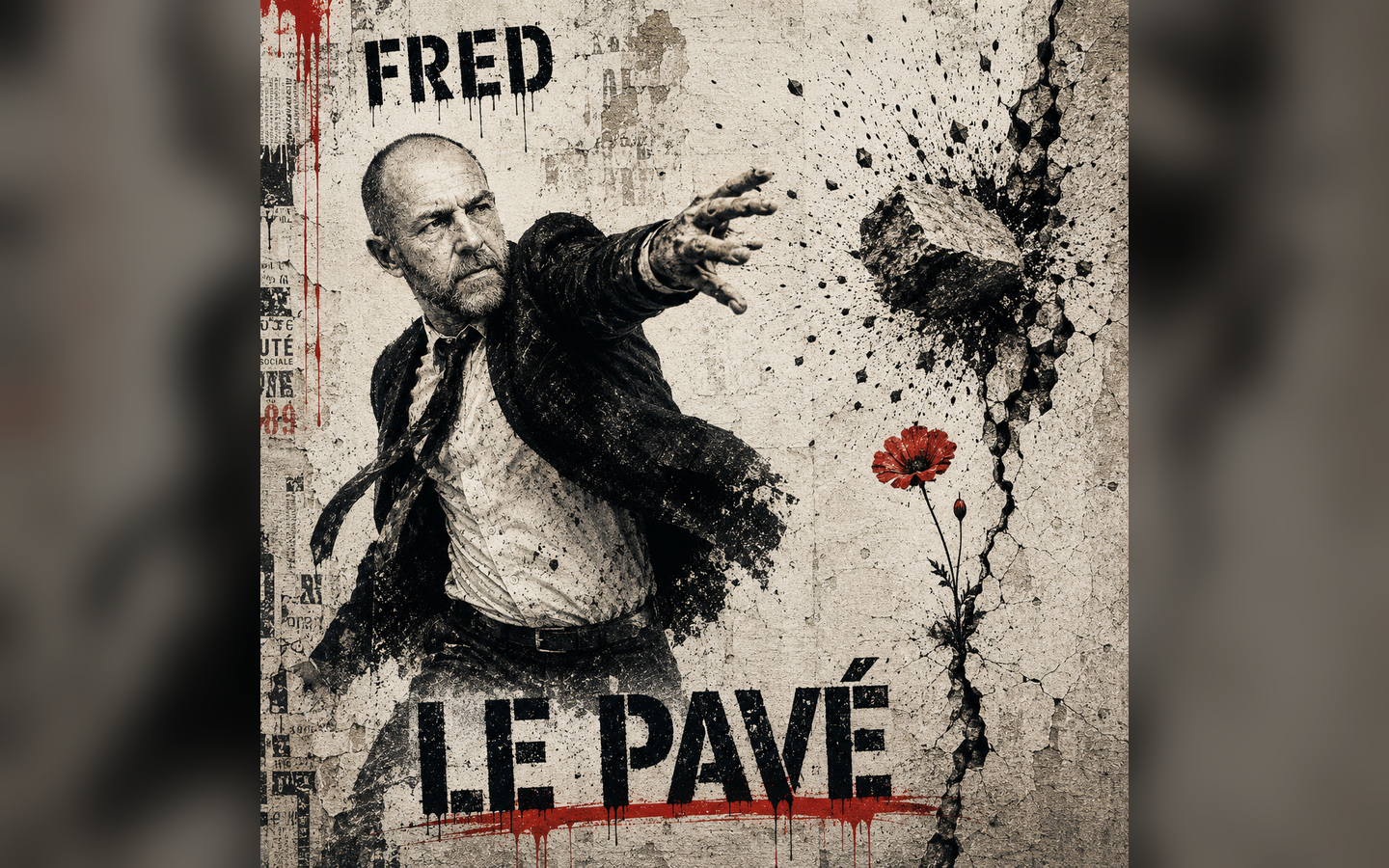
Le Pavé was not born from a plan laid out in advance. It took shape the way many things do in FRED: in fragments, in jolts, through songs that gradually began calling to one another.
At first there were texts, images, cold anger, figures glimpsed in the street, old people no one looks at anymore, children left waiting, tired bodies and seated consciences. Little by little, something formed underfoot: a ground, a material, an album.
Le Pavé is not simply an urban backdrop. It is not only the street, the pavement or hard stone beneath our shoes. It is also what keeps the traces. What we walk over without always seeing. What lives, renunciations, indifference and small failures of courage pass across.
In this album in the making, the gaze drops to ground level.
There is Les veaux regardent passer le train, where immobility becomes almost a collective scene: watching something pass that might have carried you elsewhere, then staying where you are. Pauvre vieille looks at old age, solitude, and that moment when people sometimes begin putting someone away in memory before they have even disappeared. Grand sommeil attacks digital numbness, life lived in a shop window and the social illusion of a world scrolling past while we remain still.
And then there is Les culs-de-jatte, a deliberately harsh, almost brutal title. It is not aimed at bodies that are genuinely prevented from moving, nor at lives pinned down by poverty, fear or violence. It is aimed at those who could still walk, speak and act, but gradually handed their courage over to others.
Le Pavé is therefore not trying to manufacture a “social album” in the dry sense of the term. It does not wave a placard or hand out good and bad marks. But there is no point pretending otherwise: it will not always be gentle.
At times it will be blunt. At times confrontational. There will be cynicism, cruelty, frontal realism — and a great deal of poetry. Poetry not there to soften the blow, but to give it a shape, a rhythm and a texture.
It does not only show the forgotten. It also shows forgetting being made.
It does not only show poverty. It shows the eyes that grow used to it. It does not only show the violence of the world. It also shows the small peace of those who would rather not move too much.
Perhaps that is the real thread running through the album: a poetic trial of the human gaze. What do we truly look at? What do we agree to see? And above all: what do we do with what we have seen?
Musically, Le Pavé is not locked into a single colour. Some texts call for rock tension; others need something barer, drier or more narrative. Les culs-de-jatte opened a more unexpected path: dark, urban, ritual maloya, carried by kayamb, percussion, repetition and a slow trance. The words fall almost like blows against stone.
That material is not used as exotic decoration. It becomes a way of walking, striking the ground and giving the text a physical pulse. FRED lived for several years on Réunion Island; that trace returns here not as a postcard, but as a rhythmic memory absorbed into the writing.
Le Pavé is still taking shape. Its final order has not been set. Not all of its songs are here yet. Others may come, called forth by this rough, human, popular and urban material.
But one thing is already clear: this will not be a comfortable album. It will not stroke the listener’s conscience. It will not simply say: look how hard the world is. It will also ask: and where were we while all this was happening?
At heart, Le Pavé carries a simple idea: the world does not exist only in major events, speeches, screens or promises. It is also there, beneath our feet, in what we walk over every day without always thinking about it.
An old woman. A child. A man alone. A silence. An empty chair. A train passing. Someone who could have moved and did not.
That is where Le Pavé is being built.
In that hard material. In that human dust. In the friction between compassion and inaction, between indifference and the small comforts of the self.
And perhaps, in the end, this FRED album will not simply ask us to listen to songs.
It will ask us to lower our eyes.
Not out of shame. Out of lucidity.