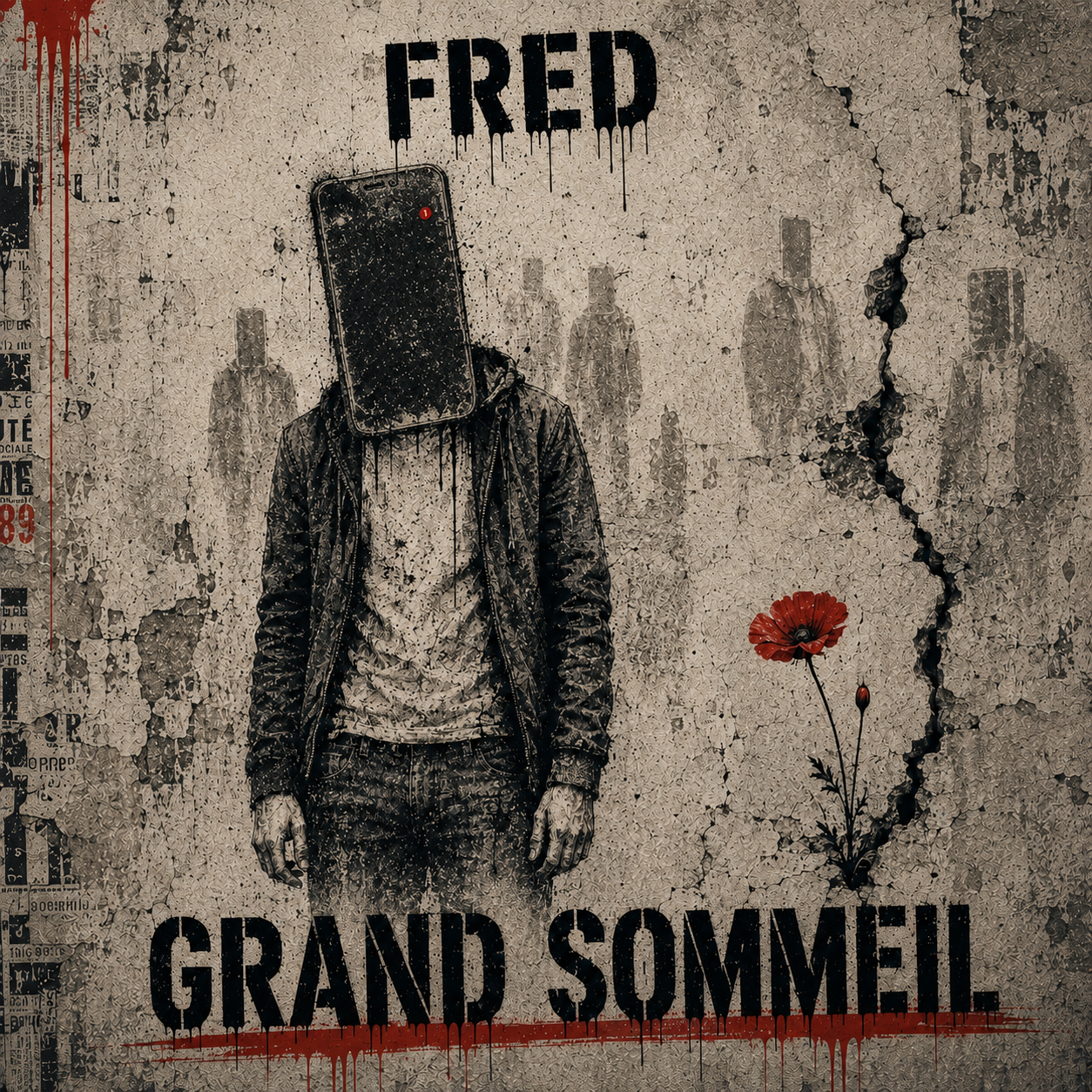
At the beginning of Grand sommeil, it would be easy to think the target is obvious.
Other people.
The ones with their eyes fixed on a screen. The ones counting reactions, waiting for the next alert, building a face out of angles, colours and tiny signs of attention. The ones who slowly turn their lives into a shop window and end up calling that a relationship.
The song could then become one more attack on social media, smartphones or an era we like to accuse of having lost touch with reality.
But Grand sommeil goes a little further.
Because the screen itself is not really the subject. It is only the place where something older and more human becomes visible: our need to be looked at, recognised, approved of, reassured that we exist.
And that is where the song starts to hurt.
The grand sommeil is not simply spending too much time in front of a screen. It is reaching the point where we confuse the sign with the thing itself. Reaction with relationship. The number of eyes on us with the experience of truly being seen. We build an image of ourselves so carefully that we no longer know what it is protecting — or what it is hiding.
In the song, everything gradually becomes a number, a pose, a view, an alert.
Even the face becomes a commodity.
We learn to smile in somebody else’s mirror. We adjust the light. We choose what should appear. We erase whatever sticks out. Then we wait for the small signal that confirms this version of ourselves has been received.
And while all that is happening, something may be falling asleep.
That is why the chorus plays with an almost absurd line: “The great sleep — that is the awakening.”
Because everything looks awake. Everything moves. Everything flashes. Everything reacts. Images scroll past, messages arrive, numbers rise or fall. Something is happening all the time.
But movement is not necessarily life.
Noise is not necessarily presence.
And being seen is not necessarily being met.
Perhaps the most interesting moment comes when the song stops speaking only about them.
At first it is they. They have nothing left in sight. Nothing left to say. They count hearts and reactions.
Then the screen cuts out.
And suddenly: we.
We get restless. We lower our eyes. We cheat. We find ourselves without filters, without a frame, without that little machine in between constantly telling us what to look at and how to look at ourselves.
At that point, Grand sommeil stops being comfortable for the listener.
Because Le Pavé is no longer pointing at some distant, caricatured crowd. It slowly turns the finger back toward us.
The question is no longer: what have they become?
It becomes: what are we doing with all of this?
That also explains the musical colour of the track. The cynical, punchy dark ragga is not there merely to carry the words. Repetition becomes almost hypnotic. The “Sleep, sleep” sounds like a lullaby reflected in the wrong side of the mirror: the machine stays awake while human beings drift off.
And the more the phrase returns, the less funny it becomes.
At the end, the screens go dark.
No frame. No counter. No pose left to hold.
Only a face.
And two hands holding nothing.
That is probably where Grand sommeil fully belongs in Le Pavé. Not because it condemns a technology, but because it looks at a habit that has become so ordinary we barely see it anymore: the way our need for other people can slowly turn into a need for signs coming from other people.
Le Pavé is drawn precisely to places like this.
Places where everyday life looks innocent until you scratch the surface a little.
And where, beneath the images, something begins to burn.