There are songs we write because we have something to say.
And then there are songs that end up revealing something we had not entirely expected.
Faisons la paix belongs to that second kind.
The song will be part of the first FRED EP, due on October 2. But it already holds a particular place in this world: almost naturally, it has become the point towards which everything else seems able to converge.
To make peace.
The phrase might suggest a soothing song, a gentle reconciliation with oneself. That is not quite what this is.
It is not about erasing anything.
Nor is it about forgiving at any cost, turning wounds into pretty scars, or pretending that time fixes everything.
Some things remain.
Some cracks do too.
The peace in this song begins instead when we stop spending our lives fighting what has become part of us.
Our mistakes. Our contradictions. Our absences. The less flattering pieces. The ones we might sometimes have wished never to carry at all.
We do not become new.
We simply learn to stop living against our own cracks.
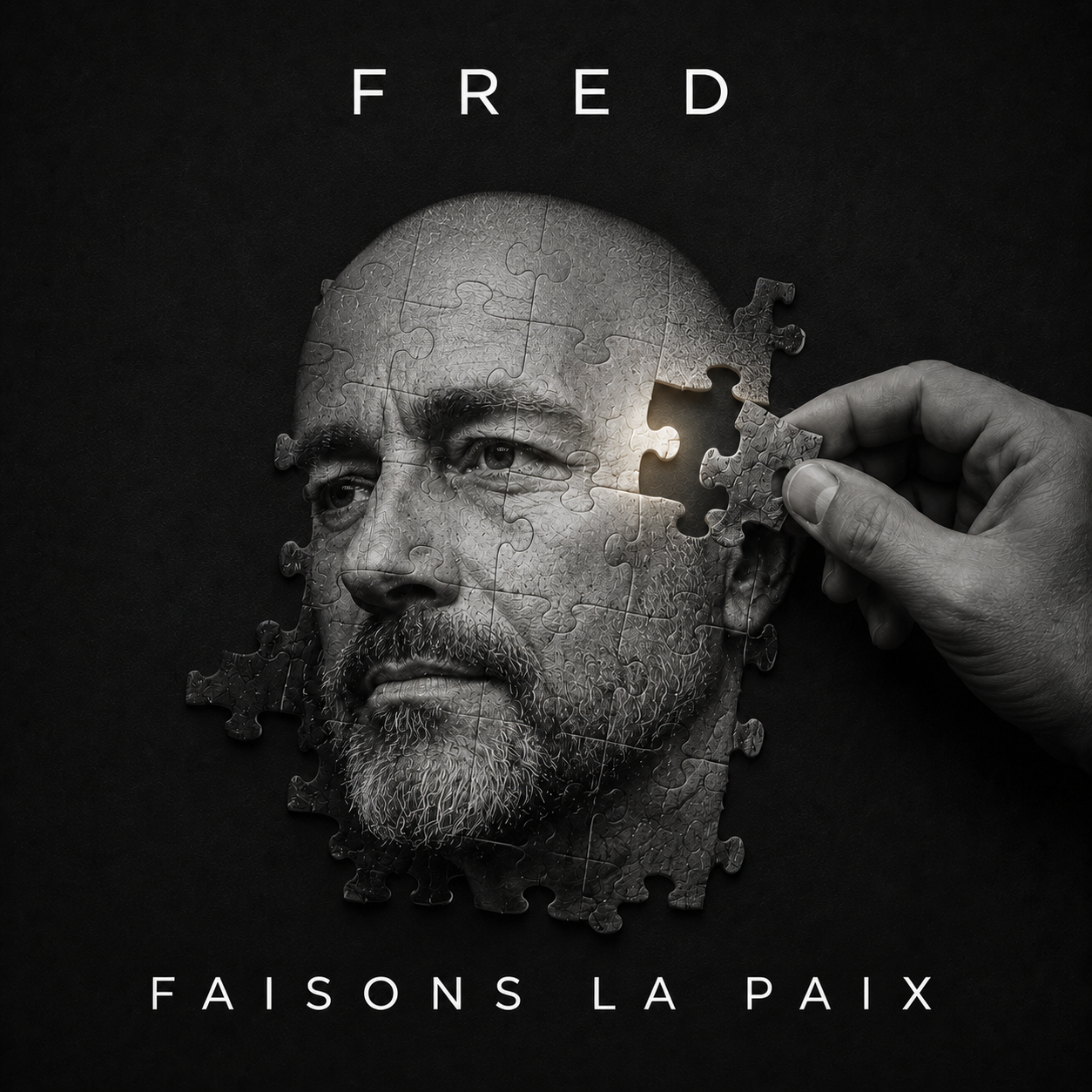
That is where the image of the puzzle came from.
An incomplete face. Pieces gradually returning to their place. Not to hide the joins, but to leave them visible.
Because a human being does not rebuild the way an object is restored until every trace of its history disappears.
What we have lived through remains.
The joins remain with us.
And that is precisely what eventually makes a face.
The idea born around Faisons la paix soon grew beyond the song itself. It became the visual thread of the entire FRED world: each song can give part of the man back to himself, each cover can add another piece, each step can make the face a little more complete.
But the final piece belongs to Faisons la paix.
Not because everything would then be repaired.
Because at that moment, nothing is missing for the face to be whole.
There is an enormous difference between being whole and being intact.
FRED has a great deal to say about that difference.
Filiation, time, loss, words, freedom, wounds, the things we did not choose and those we sometimes chose badly ourselves.
All of it leaves traces.
Faisons la paix does not try to erase them.
It simply suggests that we stop waging war on them.
And perhaps that is what the final piece of the puzzle really is: not finally finding what makes us perfect, but accepting that everything that makes us who we are now has its place.