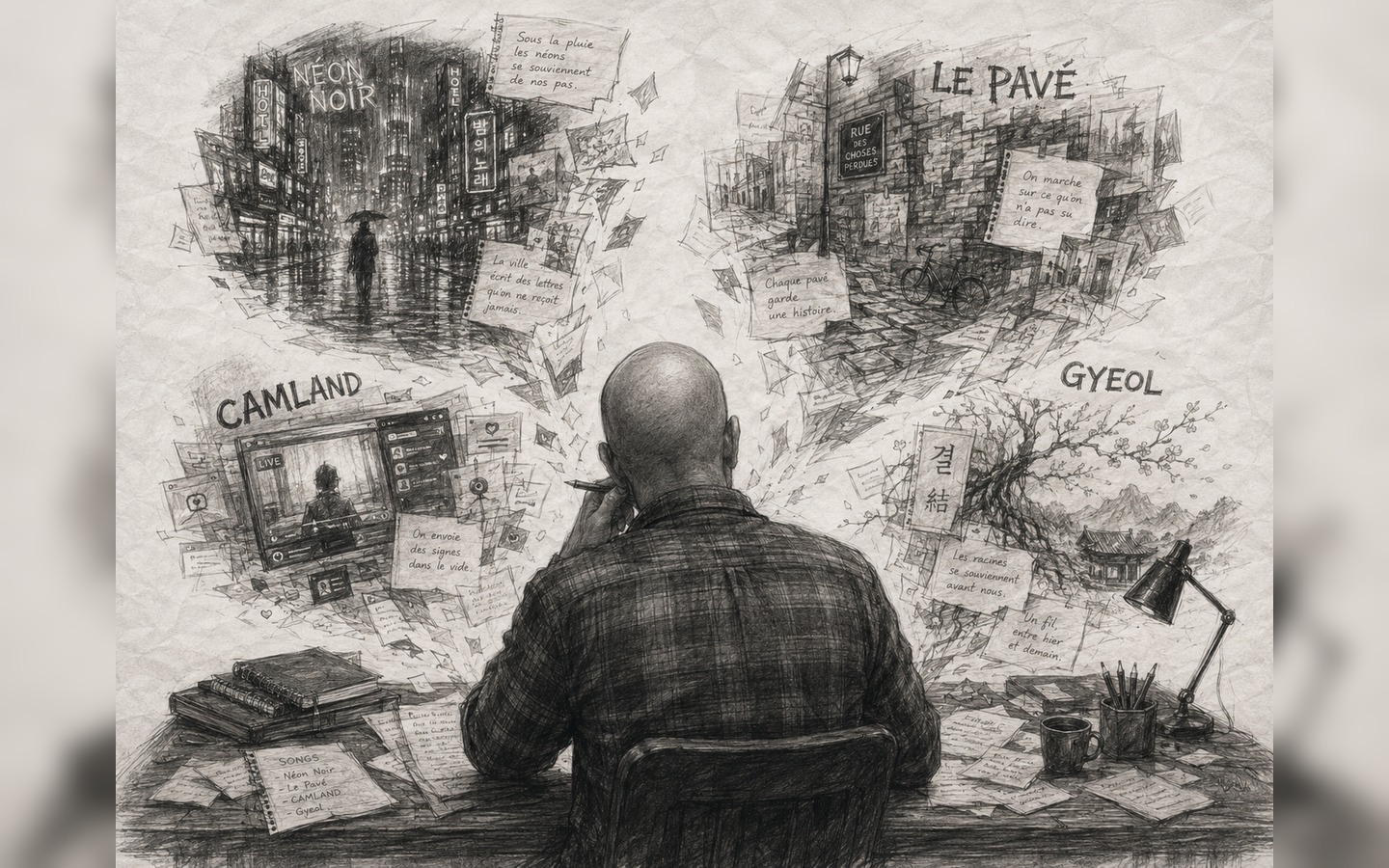
At FRED, more often than not, the songs determine the album, not the other way around. I do not necessarily start with a neat chart, a fixed concept, twelve planned tracks and a musical colour decided in advance. That would be easier to explain. But it is not how the project moves forward.
A song comes first. Through a line, an image, a memory, anger, a face, a light in a street. Sometimes through an old text that returns. Sometimes through a new idea. Sometimes through nothing more than a feeling that keeps insisting until it asks for a voice.
Then another song arrives. It is not telling the same story, yet it seems to come from the same place. It carries a similar temperature, opens a nearby door, answers what was already there without knowing it. At that point, I do not see an album yet. I see something closer to a constellation.
Only after a while do several tracks begin to look in the same direction. They share a tension, a wound, a light, a way of searching. The album then appears like a house built around the songs, not a box they have to be forced into.
GYEOL is a good example. What could first have looked like an album devoted to Korea quickly revealed a much wider territory. Themes, memories, cities, roots, contradictions and voices opened more doors than a single record could contain. GYEOL therefore became a collection able to hold several albums or EPs. The frame was not decided before the songs: the material itself made the frame larger.
The same thing happens elsewhere. Some songs naturally carry night, city streets, rain, reflections and an inward walk: they find their place in Néon Noir. Others hit harder, dealing with the social wall, indifference and people left at the edge: they call for Le Pavé. Others look at screens, digital desire, roles and the human being behind the image: they belong in CAMLAND.
But I do not want to lock a song away too early. It has to be allowed to change colour, take a wrong turn, and later reveal that it never belonged to the world I first imagined for it. When a new song shifts everything I thought I understood, that is not failure. It is a sign that the project is alive.
Almost everything begins with the text. Fragments, notebooks, lines written too quickly, things I thought I had forgotten that come back asking to become songs. Some tracks are already far along but are still waiting for the right neighbours, the right echo, the right world. A song can be ready without yet having found the other songs it needs to speak with.
The workshop matters too. My words meet different voices, perspectives and sensitivities. A conversation, a cultural nuance or an unexpected reaction can reveal something I had not seen. Sometimes that opens a song. Sometimes it shifts its colour. Only then comes the question: which world does it belong to?
This way of working also explains why I feel more at home in songs than in writing fixed on the page. Publishing a text means accepting a definitive form. My words, however, tend to move. A song gives them another kind of breathing room: the same text can be lit differently by a voice, an arrangement, rhythmic tension or a sonic texture.
That does not mean multiplying versions for the sake of it. But I do not need to believe that a text has only one possible way of existing. One musical colour may bring out its irony; another its wound, tenderness or anger. The words remain, but their reach can change.
There are my moods as well. I do not always write from the same inner place. Some periods are calmer, others more rebellious, others brighter. FRED’s worlds are also shaped by those movements. They follow human states, moments in a life, shocks, periods of calm, impulses and refusals.
And then there are encounters. Some leave only a gesture, a look, a sentence. That can be enough for a song. Others open an entire world. CAMLAND, for example, is not only an abstract idea about screens and digital desire: it also carries the trace of an encounter and what that encounter revealed behind appearances.
Sometimes a song simply sleeps. It exists, it already has a shape, perhaps even a beautiful one, but it is not in the right place yet. So it waits. Then a conversation, an image, a new song or an album coming into focus suddenly calls it back. What seemed to be on pause becomes obvious again.
I sometimes joke that I work like a winemaker. I let my vine of words grow, I let the grapes ripen and I wait before picking them. The image makes me smile, but it says something true: a song cannot always be forced. Sometimes it has to be cultivated.
That is also why FRED may seem to have so many projects. There are several doors, several worlds in the making, several directions already visible or still in reserve. It is not dispersion for the sake of doing everything at once. It is an organic method: songs move forward, images answer them, voices appear, and albums gradually take shape.
FRED is therefore not built around a single musical style. The setting can change. The music can change. The light can change. The core remains the same: words, voice, emotion and the human gaze.
We often say that we sing at human height. And perhaps it is precisely because FRED is about human beings that nothing can ever be completely fixed. People move. Thankfully.