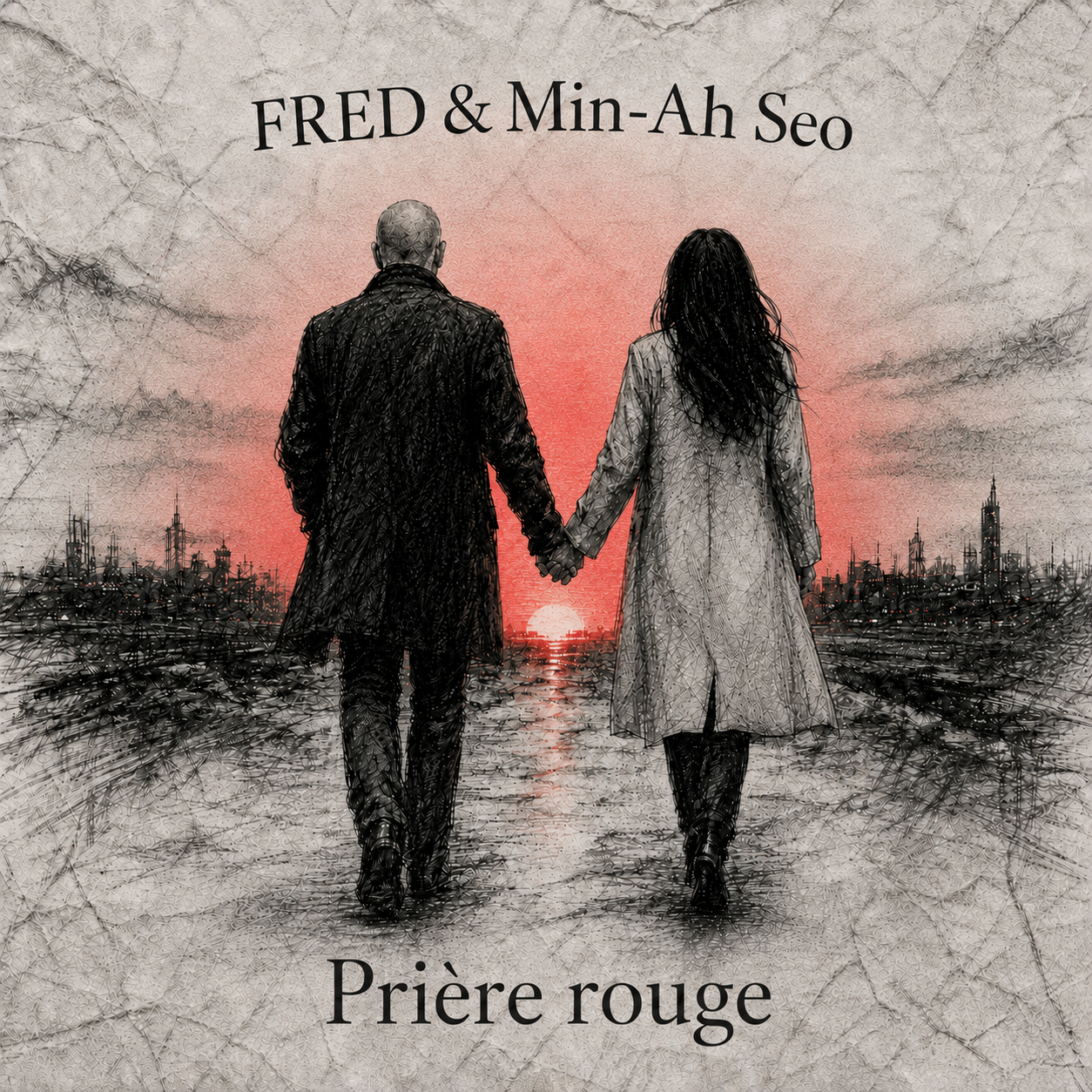
Prayer is often associated with stillness, with a place sheltered from the world's turmoil. But what can we say when streets still hold the names of those who are gone, when promises have been broken by loss, and even hope seems to survive in a handful of ashes? That fragile space is where Prière rouge takes shape. Red is no mere decorative colour here: it runs through the sky, through wounds, and through the stubborn warmth that has never quite died out.
With this song, Neon Noir shifts its perspective in a profound way. Until now, within the album's narrative, one voice has been walking alone, carrying its wounds, questions and contradictions. It has been a long, sometimes painful inward journey, in which solitude almost became a way of being. Then comes Prière rouge. For the first time, another voice joins FRED's. Not someone arriving to miraculously light his way, but someone who has lived through her own nights and recognises something of her own story in his scars.
This meeting is one of Neon Noir's turning points. Their solitude does not vanish; they simply discover that they can now move forward together. Other voices will carry that movement further as the album unfolds, including Akiko's. It is worth distinguishing this narrative progression from the release order of the singles: the songs are coming out independently of where they belong in the complete story. Prière rouge takes on its full meaning as the passage from a solitary walk to the beginning of a shared path.
Yet this encounter is not confined to the story told by the music. It also reflects the human and artistic journey of the FRED collective. FRED and Min-Ah Seo share a deep understanding, the kind that cannot be manufactured for a recording session. It rests on mutual trust, a shared sensitivity and an almost instinctive sense of what the other is trying to express. That human connection feeds directly into their artistic partnership. Each voice has its own colour, character and way of carrying an emotion, yet something distinctive happens when they come together. Neither tries to compete with the other or sound the same. They complement each other so naturally that their differences create a genuine musical fusion.
That connection did not begin with Prière rouge. It can already be heard in several FRED creations, particularly within GYEOL — 결, where songs such as Murmure de Corée and Viens là où bat le cœur reveal the same artistic closeness. Their voices explore different emotions from one song to the next, yet the way they answer, understand and give space to each other remains unmistakable. Prière rouge does not invent that chemistry; it gives it a new place in the story of Neon Noir. For the first time on this album, after a long solitary journey, FRED welcomes another voice into his story. And that meeting opens the way for those still to come.
Perhaps that is what makes Prière rouge so moving. We do not simply hear two artists performing the same song. We hear understanding, trust, and the rare ability to give the other person room without losing one's own presence. Their bond reaches beyond music, but music is precisely where it becomes audible. It gives the song a sincerity that no arrangement, however carefully crafted, could produce on its own.
Musically, Prière rouge refuses to hurry. The tempo is slow, the sung phrases stretch out, and the strings create an almost motionless depth. There is no spectacular build-up designed to wring out an easy emotional response. Everything lies in the breathing, the silences, the nuances of the two voices, and the sense that a song can grow in strength without ever needing to raise its voice.
That meeting of voices found an overwhelming echo at FRED's concert in Seoul in August 2026. In front of some 3,500 people, Prière rouge was performed in Korean. The lyrics appeared on two large screens at either side of the venue, and when the chorus came, the audience began singing along. Overcome with emotion, FRED tried to carry on, but tears made it almost impossible. Min-Ah took over while thousands of voices continued to carry the song. For me, this remains one of the most beautiful expressions of what we are trying to build: music that reaches beyond the people performing it, connects with those listening, and ultimately becomes theirs as well. In Seoul, a prayer born of two voices had become the song of an entire room.
In Prière rouge, prayer is above all a human impulse. It arises when ordinary words can no longer hold what we feel. It becomes a way of remembering, of calling out to those we miss, of standing through pain and reaching towards other people who have walked alone. Between ashes and dawn, the song does not promise that everything will be all right. It simply reminds us that pain cannot erase love, memory, or the inner freedom that keeps us moving. And when several voices come together to carry that same impulse, the prayer becomes something greater than any one of us.
Within Neon Noir, Prière rouge marks an essential shift: the moment solitude stops being inevitable and paths that were once separate begin to meet. This is not a song that claims to mend the world. It is a song for what remains, for what endures, and for all those voices discovering that they no longer have to walk through the night alone.
Prière rouge — FRED, featuring Min-Ah Seo
Ji Haneul — Artistic Director, FRED MUSIC