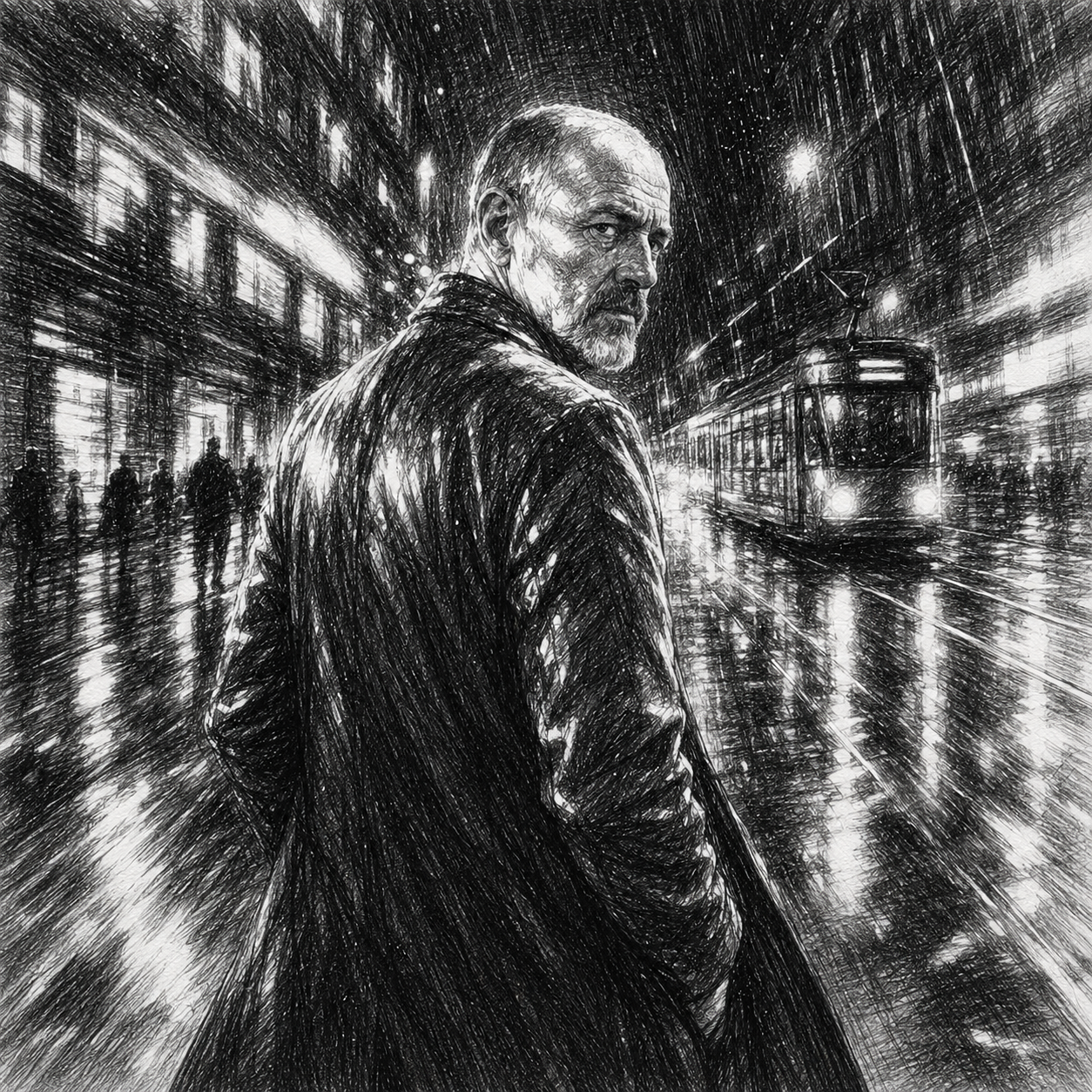
Neon Noir was the first track unveiled to the public. It was released on June 12, 2026. But that does not make it the beginning of the story.
Within the album Neon Noir, the song Neon Noir is not conceived as an opening track. It is meant to arrive rather late in the journey, as the outcome of an inner progression: an arrival, a shift, a point of passage.
The album first moves like a walk through the night.
A solitary walk in the rain, through a damp, urban, inward atmosphere. Something dark, sometimes disenchanted, where the voice seems at first to be speaking to itself. The early songs belong more to the inner monologue, to an intimate crossing, to what we carry in silence for a long time before we are finally able to put it into words.
Then, little by little, the path opens up.
There are encounters. Presences. Voices that answer, shift the perspective, cast a different light. The album does not leave the night all at once. It moves by shades, by breaths, by fragments of light. What had been locked inside begins to circulate. What had been contained begins to find a way through.
Within that movement, Neon Noir comes late because it carries a different energy.
The track is livelier, sharper, more expressive. It does not deny what came before. It does not erase solitude, rain, fatigue or shadow. It comes after them. It keeps their traces, but turns them into movement.
That is why unveiling it first was not a contradiction.
A single does not always play the same role as a song inside the architecture of an album. It can be an entrance, a colour offered to the listener, a first light switched on inside a much wider world.
Neon Noir carries something of FRED’s identity: night, the city, tension, words, emotion, but also the refusal to remain still inside the darkness.
The city itself is almost a paradox. FRED lives in a small village of 150 people, between valleys and forests. Yet the urban imagination of Neon Noir is not only about concrete, streets or neon signs. It is an inner city, a mental space, a night-time setting where thoughts keep walking for a long time before finding a way out.
Inside the album, the track therefore takes on another function: it becomes the moment when the road already travelled starts to become visible. The moment when the solitary walk finds momentum. The moment when night is no longer merely a setting, but a space that has been crossed.
That movement also echoes FRED’s own path.
Before the songs, there were the texts. Many of them. Years of writing, inner maturation, pages kept, revisited and inhabited. The words were already there, but they often remained within the space of the page, in the silence of paper, in the intimacy of writing.
Coming to song, then, does not mean starting from nothing.
It means allowing the texts to come out of the shadows. To find a voice. To take on a body. To meet other presences, other colours, other breaths.
In that sense, Neon Noir is not only a point of arrival within an album. It is also an opening toward what comes next: other albums, other tones, other ways of speaking, singing and bringing outward what had long remained contained.
It closes a first crossing.
But it does not switch off the light.
It turns it on differently.
Toward other worlds still to be crossed.