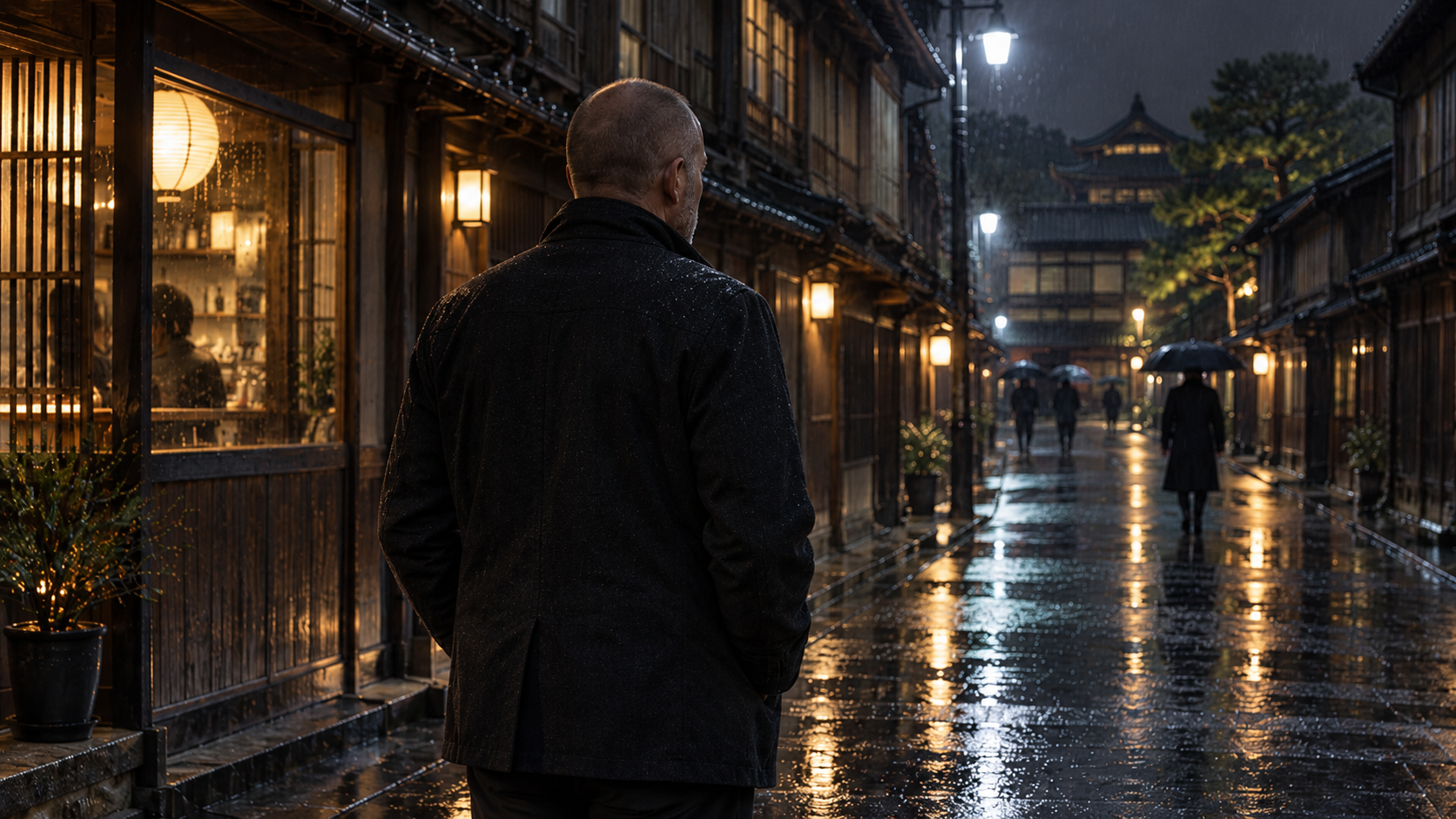
Almost nothing happens in Kanazawa.
It is raining. A cigarette burns down. A bicycle crosses the street. A couple laughs beneath an awning before disappearing. Behind the window of Blue Neon, a few voices blur away. Signs tremble in the puddles.
Nothing exceptional. Nothing that, in the moment, seems worth preserving.
And yet the whole song is there.
What tomorrow will have lost
Every day we pass through hundreds of moments like this. A particular light on a wall. A face glimpsed for a few seconds. A sentence overheard in passing. A smell. A silence. A street in the rain.
Then we move on.
The light changes, people leave, the rain dries, and what was there a few minutes earlier no longer exists.
Kanazawa grows out of that refusal to let the moment disappear completely.
Fred stays outside a little longer. He watches. He listens. He holds on to what he can. Smoke rises and dissolves, figures pass, reflections bend in the water. Everything reminds him that nothing can truly be stopped.
So one possibility remains: words.
If the moment cannot be kept in time, perhaps it can be kept in a song.
That is the deep movement of Kanazawa. At first, it is about looking. By the end, it is about saving.
A city that knows what transmission means
Choosing Kanazawa gives that idea a particular resonance.
The city still carries visible traces of its past. Its historic teahouse districts, preserved architecture and artistic traditions that are still passed on remind us that memory is not only a matter of monuments.
Preserving also means keeping gestures, skills, sounds, ways of living and ways of telling alive.
Kanazawa is not, however, a song about Japanese heritage. It is not trying to paint a portrait of a city or turn it into a postcard.
But the parallel is there.
The city preserves what time might have erased.
The song tries to do the same with a few minutes of one night.
The scale is different. The gesture is almost the same.
The memory of Neon Noir
That is also what ties Kanazawa so deeply to the world of Neon Noir.
Neon Noir is one night crossed in different ways. An urban, inward, sometimes mental night, where fractures, solitude and fragile lights change shape from one song to the next.
In some songs, the darkness must be faced. In others, you keep walking through it, wait for it to give way, or search for the light that still remains.
Kanazawa does something else.
It watches the night before it disappears.
The blue neon, the rain, voices behind glass, a figure moving away become fragments of that larger nocturnal landscape. Here, though, the point is not to defeat the darkness. It is to gather something from it.
Kanazawa may be the memory of Neon Noir.
The song that picks up what the night was about to erase.
Saving the small things too
We often reserve memory for major events, important dates and people we do not want to forget.
But a life is mostly made of something else.
Thousands of tiny moments no one will ever catalogue.
Rain one evening. A blue light. Laughter heard a few metres away. The cold against a sleeve. A few seconds in which a city suddenly seems to belong to us.
Most of them will disappear.
Kanazawa simply says that perhaps they, too, deserve to leave a trace.
The song cannot stop the smoke from dissolving. It cannot hold the passers-by or stop the rain.
It can only say:
I was there. I saw it. It existed.
And sometimes, singing is already enough to keep forgetting from having the last word.