Before FRED, there were the words. Texts, lines, fragments, notebooks, files, mental images that returned without warning. For a long time, all of that lived mainly on the page, with its weight, its silences, and that very particular quality of writing that lets each reader hear a voice of their own.
Then one question began to insist: how could those words carry differently? How could they be given breath, presence and tension beyond the page itself? Song did not arrive as a break with writing. It arrived as another way of extending it.
That is where FRED began: with a writer who did not want to leave the texts behind, but to open other paths for them. A voice, a sonic texture, a rhythm or a breath can shift a line without betraying it. They can reveal irony, hurt, anger or tenderness that reading alone sometimes leaves suspended.
Very quickly, though, the music did not remain on its own. Songs called for images. Images sometimes suggested a musical colour, an atmosphere or a frame. A cover could become an entrance. An article could offer a key. A video could catch a movement. A fragment posted somewhere could find an echo, weeks later, in another song.
At FRED, these elements are not kept in separate boxes. They circulate. A text can become a song; a song can give birth to an image; an image can reveal something the text had not yet put into words; an article can show what happened in the workshop without explaining the song until nothing is left to discover.
That is also why FRED thinks in constellations. Musical styles may change, and so may the settings, but some songs eventually recognise one another. They share a temperature, a tension, a way of looking at people. Gradually they form a world: Néon Noir, Le Pavé, CAMLAND, FRED, or other territories that will continue to appear as the songs arrive.
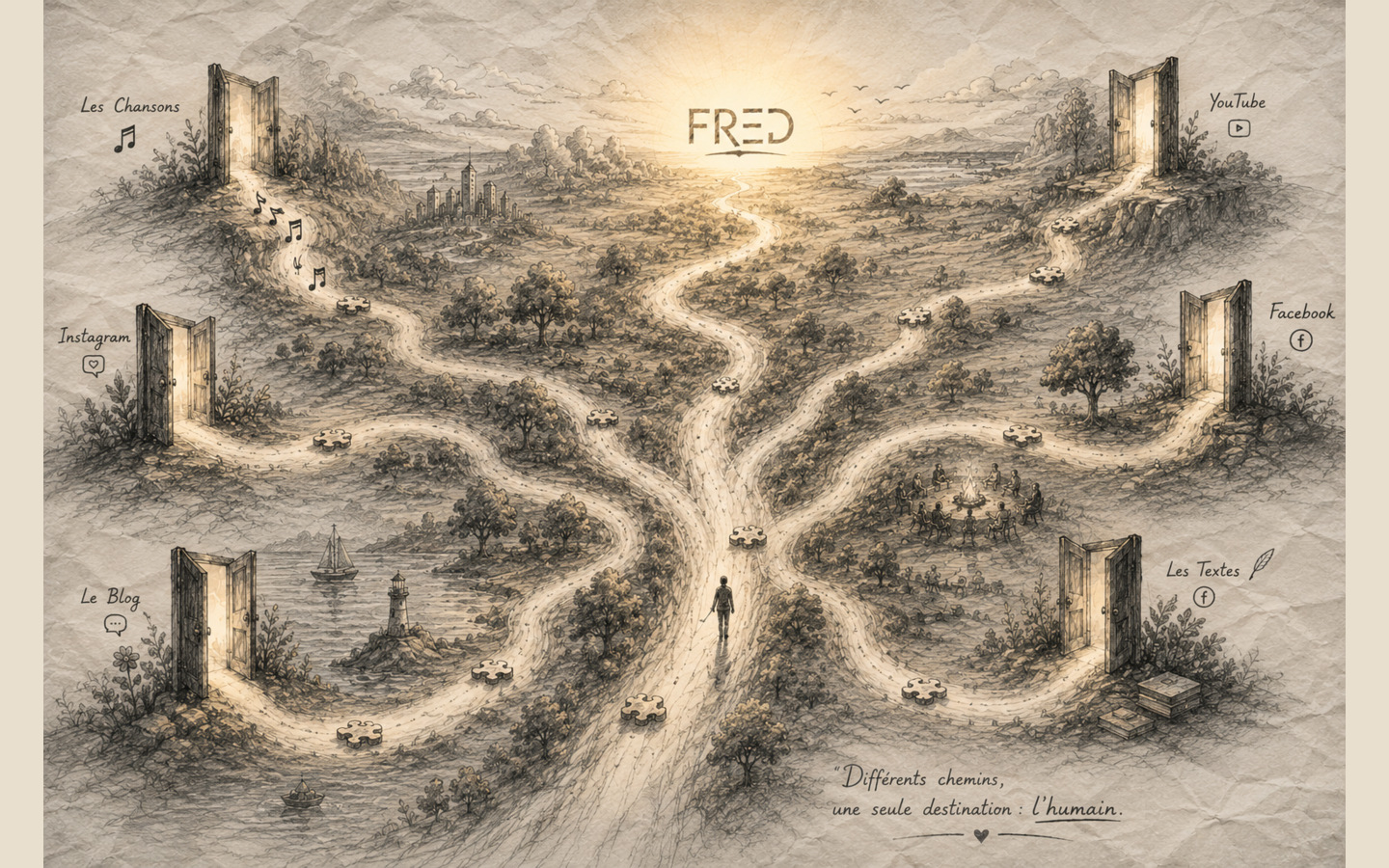
The image accompanying this article tells that story rather well. Several doors, several paths, scattered puzzle pieces, and one shared direction at the centre. You can enter through the songs, the writing, the blog, an image, a video or a post. None of those paths is compulsory, and none tells the whole story on its own.
There is no need to enter at the beginning either. Someone may discover FRED through a recent track, then go back to an older text, come across an image, and only later realise that a detail belonged to something larger. I prefer that kind of movement to the idea of a prescribed route.
Behind the scenes, the work looks much the same. It is rarely linear. A song may move from one world to another. A track may wait before finding its place. A text may remain untouched while the music is still searching for its shape. An image may arrive very early, or only when the song is nearly finished. There are trials, returns, choices, discarded ideas, and things that seemed secondary until they suddenly became essential.
Building a world therefore does not mean deciding everything in advance. It mostly means learning to recognise what belongs together. Leaving enough room for a song to surprise you, for an encounter to shift a project, for an image to open a path, or for an album to take shape differently from what was first imagined.
The words “in the making” do not mean that FRED is waiting to become something real one day. The project already exists through what is released, heard, read and seen. But it remains alive. Every new track can sharpen a direction, shift a balance or open a door that was not there before.
Among all of that, one thing remains constant. Behind the styles, tools, images, languages, screens and concepts, I always come back to the same place: the human being. What lies behind an appearance. What trembles beneath a role. What remains after anger, desire, solitude, memory or loss.
That is probably what connects all the paths on the map. They are different, sometimes far apart, but they are looking for the same destination. Music, writing and images are not three parallel projects: they are three ways, among others, of approaching the same human material.
So FRED does not ask anyone to understand everything at once. It simply offers a door that feels right to you. Listening to one song is enough. Reading one text is enough. Stopping for one image is enough. And if you later feel like taking another path, the other doors remain open.