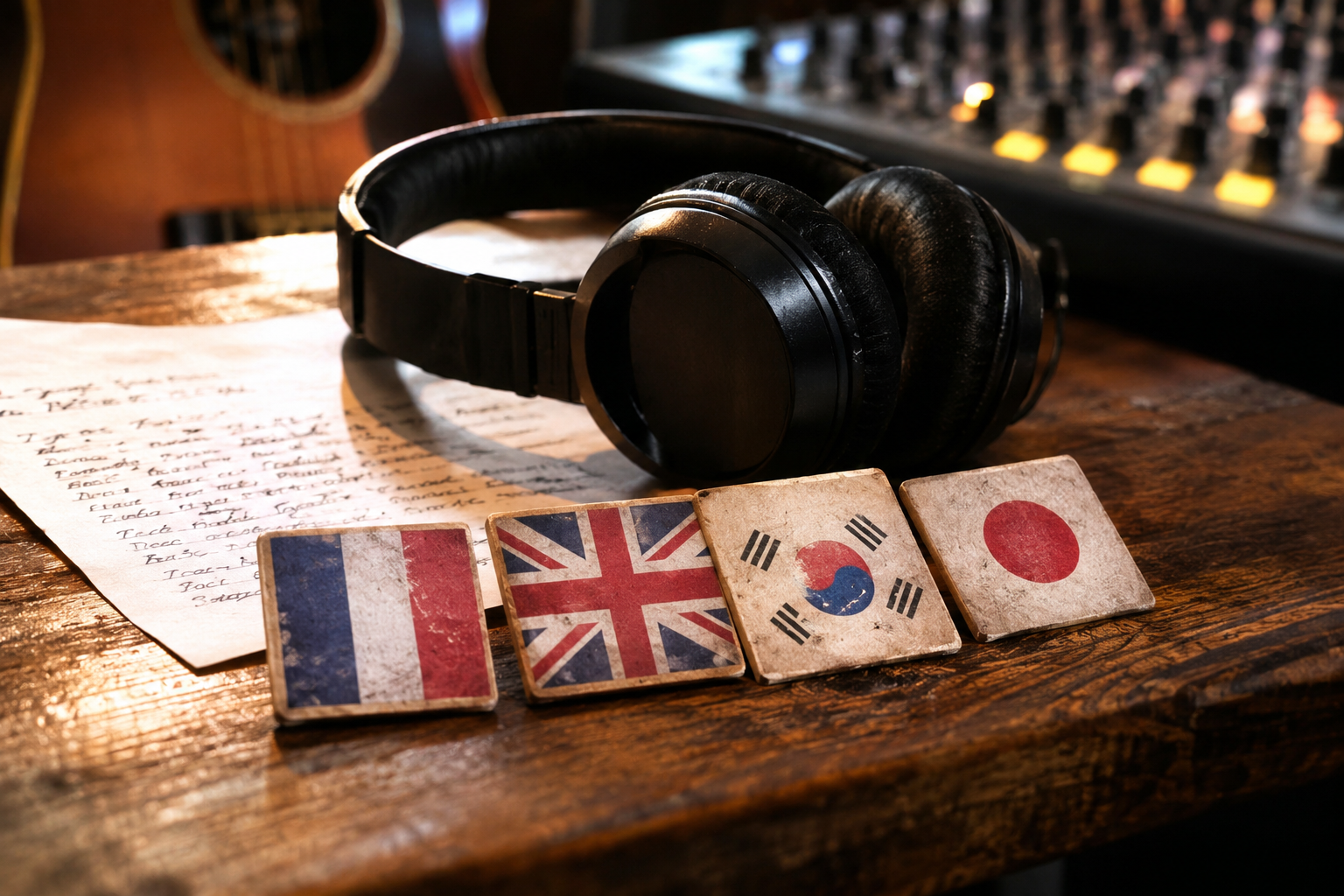
A song doesn't always tell the same story to everyone who hears it. Sometimes all it takes is a change of language, a border crossed or an image shifted for an emotion to take on a different shade. Words that seemed obvious in their country of origin suddenly become mysterious elsewhere. Some expressions resist the journey, others change, and a sentence that sounds perfectly natural in French may lose some of its power when it meets another culture. Much of FRED MUSIC's work takes place in that delicate space between languages and sensibilities.
In our previous article about Les veaux regardent passer le train, we discussed the particular challenges involved in adapting songs from the Le Pavé universe. Their irony, everyday expressions, social dimension and cultural references all present difficulties for the future Korean and Japanese versions. But those difficulties don't belong only to provocative songs. They also arise in love songs, intimate stories, poetic images and the most universal emotions. Even when a feeling is shared by everyone, the words used to express it don't necessarily follow the same path.
Over recent months, FRED MUSIC has been building a repertoire in which a work born in French may take on three other lives, in English, Korean and Japanese. We deliberately speak of sister works, rather than straightforward translations. Each needs to feel natural in its own language, respect the culture around it and find its own place in the music, while preserving the intention of the original.
Originally, we wanted to bring all four works together in a musical collection called MIROIRS. The idea was simple: listeners could find the French version and its three adaptations in a single mini-album, and discover their similarities and differences directly. Unfortunately, technical constraints in our distribution arrangements meant we couldn't bring that four-language format to life as planned. We therefore abandoned that release format and chose to distribute the sister works as separate singles, each in its own language.
That doesn't mean the works have lost their connection. Once released, listeners can find and hear the different versions on Spotify, among other services, and on the music-streaming platforms where they're available. They can move from French to English, then to Korean or Japanese, discovering how one creation changes when it meets several languages. Yet listening to the songs side by side doesn't tell the whole story. Titles and standard platform descriptions don't explain why certain lines changed, why an image was replaced or why an emotion sometimes seems to be expressed differently.
Because the differences aren't confined to the lyrics. They can be heard in phrasing, in the way a voice enters a line, in breaths and rhythmic accents, and sometimes even in the arrangements. A Korean adaptation may call for a different melodic movement from the French version. A Japanese expression may alter the natural rhythm of a phrase, while an English version may find another kind of flow in the same composition. Some transformations are subtle, others clearly audible, but they all answer one essential question: how can each language live fully within the music instead of being forced into the shape of the original song?
This work sometimes calls for choices the listener would never suspect. A French metaphor can become incomprehensible if reproduced word for word. A Japanese expression may convey a nuance that a more direct phrase couldn't capture with the same delicacy. In Korean, the relationship between people, the level of speech or the way an emotion is expressed can profoundly alter how a line is perceived. And then there are the musical demands themselves: word length, breathing, melodic accents and syllable rhythms all impose constraints of their own.
It's not enough to understand what a song says. We also need to understand what it is trying to make us feel.
As our work progressed, one idea gradually took hold: why not share this less visible side of creation with the public? Why not show how an image travels between cultures, explain certain adaptation choices or reveal what truly sets four versions of the same work apart?
That reflection gave rise to our multilingual explanatory dossier project.
Our aim isn't to offer a translation lesson or dissect every song until none of its mystery remains. Instead, we'd like to extend the listening experience by inviting anyone who's interested to discover what happens behind the scenes. An apparently simple phrase may conceal long searches, uncertainties, several possible solutions and an artistic decision that profoundly changes how a text is received. Understanding that journey can cast new light on a song we thought we already knew.
We've decided to approach this in two complementary ways. The first will be an accessible article on the FRED MUSIC website, guiding readers through a work and its various adaptations. It will explore the song's origins, its intentions, the main difficulties encountered and certain cultural or linguistic choices. The goal is to encourage people to listen to the different versions, compare them and reflect on their nuances, without reproducing the full lyrics.
The second will be a downloadable PDF dossier offering much greater depth. It will go beyond a general introduction to explore the writing and adaptation process in detail. We want to examine images, expressions, cultural differences and poetic decisions, alongside musical considerations about how each language finds its place in the melody, phrasing and rhythm. Differences that listeners can hear will then be illuminated by the artistic choices that made them necessary.
These documents will also help preserve part of each song's creative history. FRED's own voice may appear through his memories, his intentions as a writer and the challenges he chooses to describe. Anecdotes from the creative process or insights from team members may enrich certain dossiers when they add something meaningful. We want these documents to feel alive, telling the story of a human adventure as well as a linguistic undertaking.
The texts themselves will have a special place. The in-depth dossiers will present the full lyrics of all four works, in French, English, Korean and Japanese. But our approach will go far beyond bringing those texts together: we want all four audiences to have the same opportunities to understand and discover them. That means not only translating the English, Korean and Japanese works into French for French-speaking listeners, but carrying out the equivalent work in each of the four languages.
A French-speaking listener will therefore be able to discover, in French, what English, Korean and Japanese listeners actually understand when they hear their respective versions. English-speaking listeners will be able to understand the French, Korean and Japanese texts in English. The same principle will apply to Korean listeners, who will be able to explore the French, English and Japanese works in Korean, and to Japanese listeners, who will be able to discover in Japanese what the French, English and Korean versions express.
Equality between these four audiences is one of the foundations of our project. For each family of four works, this will mean twelve translations intended to convey understanding, alongside the four original texts. These won't be new singable lyrics. Their purpose will be to faithfully communicate what a native listener understands in each version, respecting the imagery, intentions, nuances and cultural references of its language. No audience will be treated as the primary recipient of these explanations. Everyone should be able to explore all four works in equal depth, without needing to master the other languages to grasp their differences.
One important condition will govern access to these dossiers: they will only be made public once all four versions of the work in question have been officially released.
This rule reflects, in particular, the need to protect and respect rights. Each sister work has its own text and release history. Before making a dossier available, especially its appendices containing complete lyrics, we will need to verify that the relevant protections, declarations and reproduction rights for the works and their adaptations are in order. We won't disclose a text intended for a future release ahead of time, or make a document available while its legal position is still unclear.
This requirement will also ensure that the work is presented coherently. A comparative dossier makes the most sense when all four works can actually be discovered and heard. Readers won't be asked to imagine a version that doesn't yet exist or compare texts whose artistic journey is unfinished. They'll be able to move between the versions, hear the differences and find the explanations needed to understand them better.
To begin this journey, we've chosen Néon Noir, a work whose four language versions have already been released. It's a particularly interesting starting point, both for the imagery it develops and for the different readings made possible by its passage from one language to another. Developing this first public dossier will help us define the shape of the new documentary collection more precisely.
There is, naturally, still work to do before these dossiers can be offered. Their presentation, the depth of the analysis and the way we connect texts to different performances all need careful thought. We'd rather create something substantial, enjoyable to explore and genuinely new than produce a series of documents that merely place four texts side by side.
This project isn't about proving that one version is better than another. It's built on a different conviction: a song can keep its identity while revealing several faces. French carries FRED's original intention, but English, Korean and Japanese can open other paths towards the same emotion. The aim isn't to erase where the work came from, or to impose a single interpretation everywhere. It's to explore what each language brings to the story.
Music has the wonderful ability to cross borders without always asking words for permission. With these future dossiers, we'd simply like to invite you to discover what happens when words decide to set out on that journey too.
And perhaps, when you next return to a song you thought you already knew, you'll hear something just a little different.
Ji Haneul