Sometimes you hear a song in three minutes. At FRED, it can take a little longer: five, six, seven minutes if that is what it needs. FRED is quite happy to ignore the usual standards when they turn into cages. A song does not always have to fit a planned, calibrated, expected length — especially when that length starts trapping the words, cutting off the text’s breath or reducing the reach of the emotion.
Blank pages already place enough limits on expression. It would be a shame if music, in turn, imprisoned what is trying to get out.
Three minutes of listening — or more — a few images, a melody that stays or slips away, a line that touches you, a voice that catches the ear. And you think the song is simply there, as though it had always existed in that form.
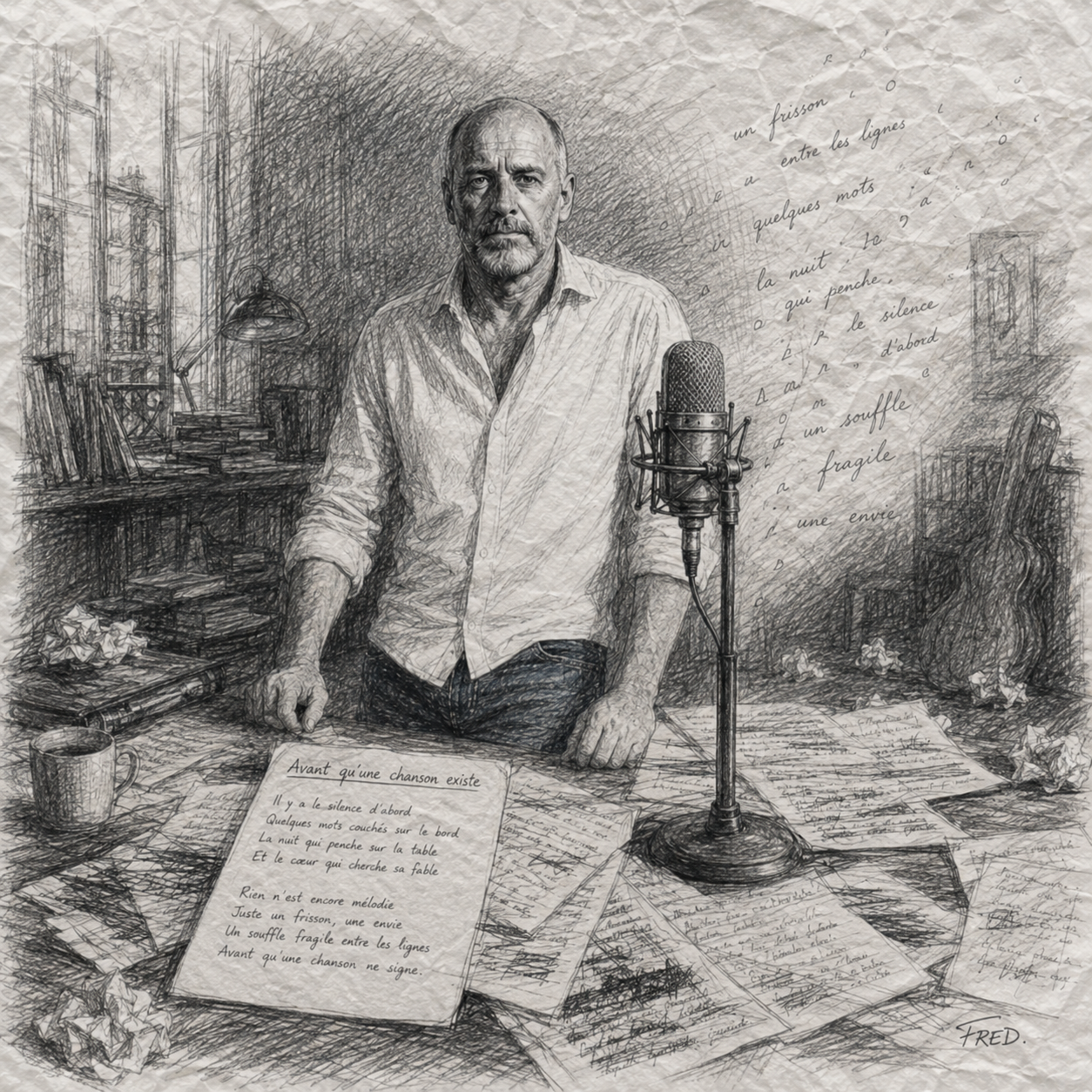
But before a song truly exists, there is everything you do not see. A song is an entire creative process.
First comes a text. At FRED, almost everything starts there: a line, an image, a wound, anger, a memory, a sensation that keeps insisting. Sometimes the text arrives quickly. Sometimes it resists. A word has to move, a line has to be cut, the natural rhythm of a sentence has to be found again, and you have to hear whether it can be sung or whether it still feels too written.
A song is not born simply because a text is beautiful. It is born when the text begins to breathe.
And sometimes one word is enough to change everything. A breath. A silence. An intonation placed only slightly differently.
Interpretation is essential in FRED’s work. It is not only about singing in tune or following a melody. It is about finding the exact emotion living inside a word, a sentence, a verse or the entire atmosphere of a text.
You will notice it often: at FRED, the voice does not always stay in the same place. There is singing, of course, but also passages that are less sung, half-sung, almost spoken, and sometimes fully spoken. The voice shifts, cracks, holds back or steps forward according to what the text asks for.
Sometimes it also plays with tone, accents and shades of diction. In “Petite fraise”, for example, FRED uses a Canadian accent in the introduction as a nod to the person who inspired the text. In the track in preparation “Fraternité”, he takes a mischievous pleasure in searching for a slightly Middle Eastern colour in the voice to strengthen the song’s impact and serve what it is telling.
Again, none of this is gratuitous. Where the voice is placed, the way a word is spoken or sung, held back or released, all contribute to meaning. It is a way of freeing the words, pulling them a little away from the page and bringing out what has been sleeping inside the written texts.
FRED, as we have said, goes in many directions. But never at random. He goes in every direction in service of the text.
Some takes are started again and again. A thousand times, if necessary. Because the crack is not in the right place. Because the intention on one word is not quite what was wanted. Because a line may sound beautiful but still does not say what it needs to say.
FRED sometimes pushes interpretation towards almost theatrical intonations. Not to play a role, but to reach a truth. From the outside it may seem strange. Yet it is necessary: to make the right emotion appear, the one that betrays neither the text, nor the atmosphere, nor what the song carries inside it.
Then comes the search for colour. What atmosphere? What tension? What light? Should the track remain fragile, almost bare? Or should it open up, grow denser, fill with shadows, pulses, strings, guitars and silences?
This is where another invisible part of the work begins: tests, versions, abandoned directions. Some ideas are interesting but do not serve the text. Others are beautiful but too smooth. Others come very close without reaching the heart of the song.
So you start again. Not to produce more. Not to pile up sounds. But to find the exact place where the text, the voice and the music recognise one another.
Within the FRED project, digital tools and artificial intelligence are part of the workshop. They replace neither intention, nor choice, nor listening. They make it possible to test, explore and try out directions, atmospheres and colours without having to mobilise an entire team around every experiment at every stage.
Because there are many tests. A great deal of searching. Many paths that nobody will ever hear.
AI then becomes a working, projection and exploration tool. It helps prepare, refine, compare and search.
But the final decision remains human. You have to choose what stays, what is rejected, what sounds right and what does not. And when a direction deserves to be kept, it still has to be worked on, understood and then reproduced naturally until it no longer sounds like an experiment but like something inevitable. What matters, in the end, is what serves the original emotion and truly belongs to the world of the track.
And sometimes, even after days of searching, weeks of maturation, hours of listening and adjustments, FRED stops, listens again and then says, dismayed — often to the great despair of the sound engineers: “We’re starting over from the beginning.”
Because it is not quite satisfying. Because almost right is still not right.
Then comes everything else: the visual, the atmosphere, the image that will accompany the song, the archives, the versions that are kept, the files that are organised, the traces of the work. Because a song is not only an audio file. It is a piece of a journey.
By the time it reaches you, it may seem obvious. But behind that apparent simplicity there are often days of searching, weeks of maturation, doubts, repeated listens, tiny decisions, things given up, and sometimes that very particular moment when you finally think: yes. There. It holds.
Only then does a song truly begin to exist.